 |
| May 26, 2015 | Volume 11 Issue 20 |
Motion Control News & Products

Designfax weekly eMagazine

Archives
Partners
Manufacturing Center
Product Spotlight
Modern Applications News
Metalworking Ideas For
Today's Job Shops
Tooling and Production
Strategies for large
metalworking plants
DURApulse GS30 AC Drives from AutomationDirect
 Automation-Direct has added new high-performance DURApulse GS30 drives that support several control modes including sensorless vector control, closed-loop flux vector control, and torque control in a compact package. The GS30 series expands the DURApulse family by adding internal tension control loop expanded parameter sets for greater versatility, as well as optional EtherCAT and single- or dual-port EtherNet/IP communication cards. GS30 drives support up to four independent induction motor parameter sets or control of a single AC permanent magnet motor. Sizes up to 3 hp for a 230-VAC single-phase input, 50 hp for a 230-VAC three-phase input, and 100 hp for a 460-VAC three-phase input. This series offers PID control, built-in PLC functionality, and STO capability typically found with more expensive high-performance AC drives.
Learn more.
Power steering systems for warehouse and autonomous vehicles
 Allied Motion has introduced the electric power steering (EPS) series for steer-by-wire warehouse vehicles, autonomous AGVs, and similar material transport vehicles. This compact system includes a fully integrated motor, gearbox, controller, and optional output pinion. It is available in three frame sizes and 16 models to cover virtually any electric steering requirement in applications from small pallet lifters to AGVs/AGCs to multi-ton reach trucks. An optional, patent-pending feature, Turning Wheel Absolute Position Control, allows the controller to know the turning wheel position without external sensors.
Learn more.
New brushless motors maximize power density
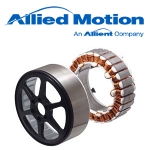 Allied Motion Technologies has introduced the KinetiMax 95 High Power Drive (HPD), an outer-rotor brushless motor. This frameless motor is designed to maximize power density for its volume with a nominal output torque of 2 Nm at 2,300 RPM, resulting in 480 W of continuous output power. At only 37 mm axial length, this compact stator-rotor set is an ideal solution for applications such as material handling systems, AGVs, mobile robots, handheld power tools, and more.
Learn more.
Compact rod motors: Effective linear thrust generation
 RDM-A Series rod motors from Akribis Systems are great for space-constrained applications requiring high motor forces and smooth linear motion. These compact motors feature a tubular design to distribute magnetic flux evenly along the circumference of the stator. They achieve continuous forces from 2.1 to 137.8 N and peak forces from 6.2 to 413.4 N. An air gap between the coil and magnet track enables non-contact axial linear movement and steady force production over the length of the stroke, and ironless construction ensures cog-free motion.
Learn more.
NORD's heavy-duty drive systems tackle tough industrial applications
 Industrial gear units from NORD DRIVE-SYSTEMS are used for a variety of heavy-duty applications, providing high output torques and long service life with minimal maintenance. Combining high-efficiency motors and dynamic VFDs, users get high performance and smooth operation. Learn which drive systems are used for which real-world applications in industries including grain, cranes and hoists, wastewater, food and beverage, and bulk material handling. Good info here.
Read the full article.
XYZ nanopositioning stage for scanning and positioning in photonics and microscopy
 PI's P-616 XYZ Piezo Nanoposition-ing Stage, based on a parallel-kinematic design, features a single, lightweight moving platform for all three axes. It offers high precision (sub-nanometer resolution) and dynamics in a compact package. Known as the NanoCube®, it is the smallest and lightest system with capacitive feedback, providing a 100-µm linear travel range in three degrees of freedom.
Learn more.
Robot with longer reach handles heavier payloads
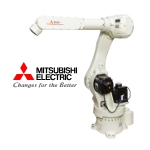 The new RV-35/50/80FR robot series from Mitsubishi Electric Automation is ideal for handling large workpieces and heavy objects. This series has a max reach of almost 83 in. (2,100 mm) and a max payload over 175 lb (80 kg), so it's a great solution for palletizing and machine tending. These robots have a wide range of safety functions, including position and speed monitoring, and simplified installation and programming when paired with Mitsubishi Electric's MELFA Smart Plus card.
Learn more.
Linear servo press solutions from Tolomatic
 Improve your pressing systems with electric linear actuators from Tolomatic. While hydraulic presses are a traditional choice in many manufacturing applications, a new generation of high-force Linear Servo Press technologies is now replacing high-maintenance hydraulics. They offer significant advantages in precision, programmability, energy efficiency, reliability, and flexibility.
Learn more.
Tech Tip: What is a stepper motor linear actuator?
 What is a stepper motor linear actuator (SMLA), what types are available, and what can they do for your linear motion designs? Find out in this informative Thomson video. Learn how precision lead screws can be combined with a stepper motor in a number of ways, and discover which type can benefit your linear motion applications.
View the video.
Brakes for high-speed SCARA robots and more
 Precise positioning of semi-conductor wafers during SCARA assembly operations requires instantaneous braking and holding power while minimizing heat in the system. The latest compact and slender Miki Pulley BXR-LE brake models provide the needed, perfectly controlled braking in a confined area of the system using minimal power. The braking response and holding power of this power-off engaged brake makes it ideal for this and other high-speed applications. The BXR-LE brake uses 24 VDC for a split second to overcome compression spring inertia to open the brake, then consumes only 7 VDC by utilizing the BEM power control module.
Learn more.
Automated piece-picking solution
 The MI.RA/ OnePicker is a new and fully automated intelligent piece-picking solution from Comau. The easy-to-use, AI-backed, and collaborative solution reduces upstream process times, saving time, energy, and resources for warehouse, e-commerce, and other applications while increasing overall productivity and cost efficiency. Designed to autonomously pick miscellaneous objects from the same bin, it's a smart way to eliminate unsustainable sorting activities. Comes with Comau's Racer5 six-axis cobot.
Learn more.
Unlock cost savings: Revolutionary GAM GPL Gearbox
 The GPL planetary gearbox, when paired with your preferred servo motor, delivers a solution that can match the fit and performance of direct drive motors while offering significant cost savings. With <6 arcsec backlash, GAM says this gearbox outperforms all other zero-backlash gearboxes on the market, making it the ideal choice for your applications. Discover how one company realized significant savings by replacing multiple direct drive motors with the GPL gearbox in a modular housing.
Read the GAM application story.
Bosch Rexroth new linear motor modules
 Fast, compact, and precise. These properties characterize the new linear motor modules (LMM) with integrated screw-free direct drive from Bosch Rexroth. The axes are available in sizes 140, 180, and 220 mm and feature a zero-backlash direct drive. They complement the existing linear motion technology portfolio as a ready-to-install solution offering excellent value for money. The linear motor modules are available in all sizes with iron-core linear motors. Standard strokes are up to 1,540 mm and forces up to 2,400 N.
Learn all the specs and options.
OnRobot doubles payload capacity of its grippers
 OnRobot's new 2FG14 and 3FG25 electrical grippers for heavy-duty, collaborative applications are now launching along with the new machine tending solution AutoPilot powered by D:PLOY, developed in collaboration with Ellison Technologies. The new three-fingered 3FG25 gripper provides users with 25 kg (55.1 lb) of payload power in a compact, all-electric, lightweight form, unlocking the potential of the latest cobots. Ideal for CNC machine tending, the 2FG14 is a lightweight parallel-finger gripper with a payload of 14 kg (30.8 lb). It doubles the payload and gripping force of OnRobot's popular 2FG7 gripper while also providing 30% more total stroke.
Learn more.
Linear guide system corrects misalignments
 Bishop-Wisecarver's UtiliTrak® linear guide system includes vee rails for precision and open rails for misalignment float to provide smooth and accurate motion on inaccurate structures. Because precise parallelism is difficult to achieve, it is not uncommon for mounting surfaces to be slightly out of parallel. UtiliTrak's design compensates for mounting errors and does not require absolute parallelism for accurate operation. Genius.
Learn more.
World first: Photonic laser thruster propels simulated spacecraft
Y.K. Bae Corporation of Ustin, CA, recently announced that their proprietary photonic laser thruster (PLT) has successfully accelerated a 450-gram (~1 lb) spacecraft simulator with pure laser light for the first time in history.
The project was funded by a Phase II grant of NASA Innovative Advanced Concepts (NIAC), which funds the most promising ideas for next-generation NASA space missions.
Conducted in a Class 1,000 cleanroom, Y.K. Bae's demonstration amplified photon power 400 times to achieve photon thrust up to 1.1 milliNewtons by bouncing photons several hundred times between two laser mirrors. The amplified thrust successfully propelled a gliding platform along a 2-m frictionless air track, simulating zero-gravity.
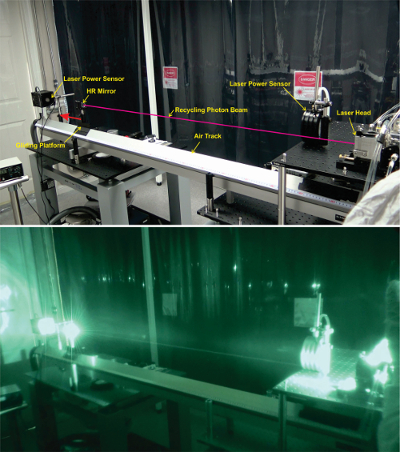
"Moving a 450-gram platform unequivocally validates the useful power-to-thrust ratio of PLT," said Dr. Claude Phipps, Chair of International High Power Laser Ablation and Directed Energy Symposium. "I can see future development that includes optical cavities that span many kilometers achieved with precise mirror alignment to enable maneuvering spacecraft many kilometers apart, and propellant-free propulsion of satellites in formations."
The PLT demonstration simulated beaming thrust between vehicles, which also included slowing and stopping the simulator. Benefits of a PLT spacecraft system include a dramatic reduction in fuel consumption in a wide range of space applications, such as orbit adjustments, drag compensation, and rendezvous and docking. The thrust-beaming capability of PLT further enables a distributed multivehicle approach, a revolutionary departure from the "all-in-one" single-spacecraft approach.
Video: Photonic laser thruster propels simulated spacecraft.
"PLT technology has the potential to revolutionize space mission designs," said Dr. Mason Peck, Associate Professor in Mechanical & Aerospace Engineering at Cornell University, who has also served as NASA's Chief Technologist. "Fully developed PLT could serve current commercial and non-commercial needs by increasing the life of LEO satellites, and therefore reducing mission costs. For the future, this unlimited-impulse technology opens doors to applications that are currently impractical, like persistent, precision formations of multiple satellites."
The Y.K. Bae team is currently developing space-qualifiable PLTs, and scaling up PLT in thrust and operation range. "Our next milestone is a flight demonstration in low earth orbit, which will prove the technology of PLT-enabled precision formation flying and stationkeeping with small satellites," said Dr. Bae, CEO of Y.K. Bae.
Source: Y.K. Bae Corp.
Published May 2015
Rate this article
View our terms of use and privacy policy