
 |
| October 13, 2015 | Volume 11 Issue 38 |
Mechanical News & Products

Designfax weekly eMagazine

Archives
Partners
Manufacturing Center
Product Spotlight
Modern Applications News
Metalworking Ideas For
Today's Job Shops
Tooling and Production
Strategies for large
metalworking plants
How ball spline coatings enhance performance and extend component life
 According to Thomson, "Precision ball splines have gained popularity as an ideal choice for applications that require low-friction linear and rotary motion. These components, which utilize a single splined shaft, enable complex movements in multiple directions." But how do you keep these ball splines performing at their peak for longer? Coatings can do the trick, and Thomson has three of them: black oxide, hard chrome plating, and nickel plating. Learn more about these coatings and which one makes the most sense for your precision ball spline solution.
View the video.
Key factors for ball screw applications
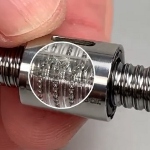 Learn the six key factors that should be considered when specifying ball screw assemblies in motion control applications. PCB Linear gathered a panel of experts in the field of linear motion to concentrate on this important topic -- particularly when it comes to the company's new miniature ball screw product line. Learn about precision and accuracy, orientation, speed and acceleration, duty cycle, linear motion travel, and load capacity. Podcast available too.
Read the PCB Linear blog.
3D printer uses pellet extrusion system instead of filament
 The latest addition to 3D Systems' industry-leading portfolio of EXT Titan Pellet systems is the EXT 800 Titan Pellet. With a build volume of 800 x 600 x 800 mm, this thermoplastics 3D printer harnesses the speed, reliability, and efficiency of the company's large-format pellet systems in a more compact unit with lower upfront investment. Use this machine to fabricate more modestly sized functional prototypes, tooling, fixtures, sand casting patterns, thermoforming molds, and end-use parts. Markedly faster than competing FFF and FDM printers, and up to 10X reduced material costs compared to filaments.
Learn more.
Test your knowledge: High-temp adhesives
 Put your knowledge to the test by trying to answer these key questions on how to choose the right high-temperature-resistant adhesive. The technical experts from Master Bond cover critical information necessary for the selection process, including questions on glass transition temperature and service temperature range. Some of the answers may surprise even the savviest of engineers.
Take the quiz.
World's first current-carrying fastening technology
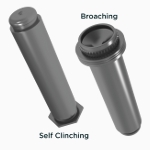 PEM® eConnect™ current-carrying pins from Penn-Engineering provide superior electrical connections in applications that demand high performance from internal components, such as automotive electronics. This first-to-market tech provides repeatable, consistent electrical joints and superior installation unmatched by traditional fastening methods. Features include quick and secure automated installation, no hot spots or poor conductivity, and captivation options that include self-clinching and broaching styles.
Learn more about eConnect pins.
New flat quarter-turn clamping fastener
 IMAO Fixtureworks has expanded its One-Touch Fastener lineup to include a new quarter-turn clamping fastener that features an innovative flat design and is ideal for clamping in limited spaces. The QCFC flat quarter-turn fastener features a recessed body that protrudes only 2 mm from the mounted surface, a knob that rests flush inside the body, visible ON and OFF markings for safety, and an audible click when fully turned to clamped or unclamped position.
Learn more.
Bellows and disc couplings with higher torque capacity
 Ruland Manufacturing now offers bellows and double disc couplings with bore sizes up to 1-3/4 in. or 45 mm for use in systems with torque up to 1,400 in.-lb (158 Nm). High-torque applications in precision semiconductor, solar, conveyor, and factory automation applications often use these shaft sizes. Ruland disc and bellows couplings accommodate all forms of misalignment, are zero-backlash, and have a balanced design for reduced vibration at speeds up to 10,000 rpm.
Learn more.
Simplify your designs with slewing ring bearings
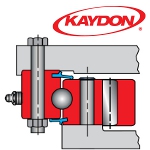 According to Kaydon Bearings, "A slewing ring bearing has rolling elements designed to create a reactive moment within the bearing's dimensions envelope to oppose applied (overturning) moment load," so you can use one bearing instead of two, reducing the height requirements, and even improve performance. Slewing ring bearings can also simplify a drive system by utilizing gear teeth on the inner or outer race. Learn all about slewing ring bearings in this informative article.
Read the Kaydon whitepaper.
Jet valve for ultra-small dispensing
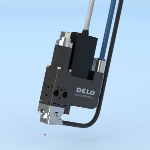 DELO's DELO-DOT PN5 LV pneumatic jet valve is designed for micro-dispensing low-viscosity adhesives and other media in miniaturized applications. Thanks to its compact design, it also requires very little space to install in production systems. Interchangeable nozzles with different diameters and a flexible, adjustable plunger stroke ensure precise and reliable applications at different droplet sizes. Volumes of as low as 1 nl can be achieved, which corresponds to droplet diameters of 250 µm or less.
Learn more.
Stainless steel constant-torque flush-mount hinge
 Southco has introduced a flush-mount version of its popular and durable E6 constant-torque hinge. Its low-profile, corrosion-resistant package makes it an ideal solution for maximizing security, longevity, and aesthetics. It offers high torque for demanding applications while maintaining its low profile. Lots of uses.
Learn more.
Claw vacuum pump for industrial applications
 Vacuum expert Leybold has added a new model to its proven CLAWVAC dry claw vacuum pump series: the CLAWVAC CP B. This innovative, rough vacuum pump, designed for robust processes including food processing, material handling, and environmental industries, is powerful, energy efficient, and easy to clean. The intuitive handling of this unit is mainly due to its functional design, which features a pair of claws that rotate in the cylinder with no contact or wear. Its separate gearbox prevents oil contamination. The design ensures short downtimes and long service intervals: 20,000 hr between oil changes and up to 48,000 hr between general overhauls.
Learn more.
DualVee linear guides and tracks used in warehousing
 See how Bishop-Wisecarver's DualVee® motion tech can add huge benefits to warehousing operations. This video highlights two applications: a manual storage and retrieval system and an automated storage and retrieval system of long aerospace-grade carbon fiber in sub-zero temps. Patented DualVee guides and tracks keep operations running smoothly.
View the video.
Build-to-order knobs and hand hardware
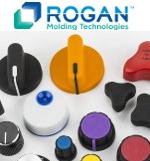 Rogan Corp.'s innovative use of two-shot plastic injection and insert molding has been providing customers with high-quality plastic clamping knobs, levers, and control knobs for almost 90 years. Rogan offers concurrent engineering, product design, and assistance in material selection to ensure customer satisfaction for standard or customized parts, with a focus on cost optimization and on-time delivery. Custom colors, markings, decorative inlays, or engineered materials to meet special requirements, such as adding extra strength or utilizing flame-retardant material, are all offered.
Learn more.
Slewing ring bearing made of wood and plastic
 The PRT-02-30-WPC slewing ring bearing is another step forward by igus toward integrating renewable raw materials into industrial production. Made of 50% wood and 50% high-performance plastics, the cost-effective and lubrication-free slewing ring bearing balances strength and durability with a proven low CO2 footprint. The materials incorporate solid lubricants, making the new slewing ring bearing smooth running and maintenance-free.
Learn more.
Flex Locators for quick fixture changeover
 Flex Locators from Fixtureworks are designed for quick changeover of small and large fixtures, automation components, and more. They are ideal for applications that require frequent disassembly, providing excellent repeatability for locating and clamping in a single operation. Manual and pneumatic versions are available. Just turn the handle, knob, or screw!
View the video.
'Off-the-shelf' semitrailer becomes Army missile launcher
By Jason B. Cutshaw, USASMDC/ARSTRAT

A tactical ballistic missile being launched off a 25,000-lb-capacity Transportable Target Launcher, or 25K TTL, designed by the U.S. Army Space and Missile Defense Command/Army Forces Strategic Command. [Photo Credit: U.S. Army photo]
In times of continuing budgetary constraints, the U.S. Army Space and Missile Defense Command/Army Forces Strategic Command, or USASMDC/ARSTRAT, is making an extended effort to save taxpayers by not only designing low-cost targets, but also by designing low-cost launch vehicles.
Members of the USASMDC/ARSTRAT Test Execution Support Division developed a transportable, mission-configurable, 25,000-lb-capacity Transportable Target Launcher, or 25K TTL, to support Department of Defense operational testing of theater-class tactical ballistic missile targets.
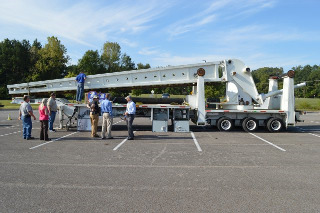
The Transportable Target Launcher (25K TTL) undergoes inspections before returning to the Naval Surface Warfare Center Crane in Indiana for maintenance prior to future test missions. The 25K TTL is designed to support Department of Defense operational testing of theater-class tactical ballistic missile targets. [Photo Credit: Jason B. Cutshaw.]
"The 25K TTL is a rapidly deployable (C-17 and C-5 transportable), treaty-compliant rail launch platform for theater-class tactical ballistic missile targets," says Bryon Manley, SMDC Technical Center Test Execution Support Division chief. "The 25K TTL is a cost-effective, transportable launcher that can expand the number of available launch sites, adding a more comprehensive selection of threat scenario geometries for tactical ballistic missile target testing on national ranges."
SMDC developed two 25K TTLs, at a cost of approximately $3 million, that are rapidly deployable. They were designed, analyzed, built, and tested using a modified commercial off-the-shelf semitrailer and hydraulic crane as a portable launch platform.
"Our division is about low cost, so we design things based on commercially off-the-shelf available items so that they are cost effective," says Stephanie Chrisley, SMDC general engineer.
Utilization of the TTL is a cost-effective means of presenting test scenarios in a threat-representative construct due to its ability to operate at both unimproved and improved range sites. Additionally, the launcher is transportable by air or land, permitting use at all ranges. The missile launcher can begin operating within 15 minutes of setting up.
"We can take it onto an unimproved launch site with one generator and a small crew and we launch ballistic missile targets with no problem," Chrisley says.
The TTL, which can hold a missile up to 48 ft long and handle up to 73,000 lb of rocket thrust, is undergoing inspections before returning to the Naval Surface Warfare Center Crane in Indiana for maintenance prior to future test missions.
"We brought it out of storage to have it inspected because we will be using it for a flight test in the spring of 2016," Chrisley says.
The 25K TTL is capable of being transported to a launch site, converted to a fixed installation before target loading and launch, reconfigured for transport after launch, and returned to storage or emplaced for a follow-on mission.
"This gives us the flexibility to launch in any area we want that does not necessarily have to be an improved area; it can be any open area where we can set it up with a small crew," says Kevin Creekmore, Test Execution Support Division acting director. "It does not need existing power, it does not need existing communication lines, and it does not need existing infrastructure. It gives us the flexibility to launch at just about any angle that we want using the adjustable boom.
"We use it to support many different tests for many different customers," he adds. "We have several tests upcoming in the next few years."
SMDC has also developed targets to be launched by the TTLs. Made from existing materials, the program was named Zombie. Zombie uses government-owned material components that have reached the end of their useful lives and are subject to consideration for demilitarization. Using this government hardware instead of demilitarizing it ultimately saves taxpayer dollars.
The command developed the Zombie targets that cut expenses from the around $30 million each for high-end targets to approximately $4 million for SMDC's low-cost Zombie.
"We look for unused rocket motors or some that are going to be demilitarized and just thrown away. The motors are generally still good, so we try to repurpose those with new avionics and new front-end sections and launch them as low-cost targets," Chrisley says.
Published October 2015
Rate this article
View our terms of use and privacy policy