
 |
| October 18, 2016 | Volume 12 Issue 39 |
Mechanical News & Products


Designfax weekly eMagazine
Archives
Partners
Manufacturing Center
Product Spotlight
Modern Applications News
Metalworking Ideas For
Today's Job Shops
Tooling and Production
Strategies for large
metalworking plants
Siemens Meet at the Machine: Be productive from day one of new CNC machine delivery
 Traditionally, many programming, validation, and training activities begin only after a machine is installed. Not anymore. Meet at the Machine is Siemens' new initiative uniting machine builders, software, and automation for next-level CNC through a continuous digital thread across engineering, programming, virtual validation, and execution. By pairing a Digital Twin with Digital CNC powered by SINUMERIK, manufacturers can prepare, validate, train, and optimize workflows before your specialized machine's physical delivery! TRAK Machine Tools is the launch partner -- see what they are doing.
Learn more.
How to master metal powder management in 3D printing
 What's the real cost of "good enough" powder tracking for powder-bed fusion 3D-printing machines? According to Tim Wischeropp, CEO and Co-Founder of amsight, the technology is rife with hidden costs. Every cycle, every handling step, every exposure, and every mixing decision plays a part. Surprisingly, though, with the right strategy, users can turn their losses into a competitive edge. Learn how.
Read the full article.
Aluminum oxide filament for FDM printers
 Virtual Foundry, the company that brought us 3D-printable lunar regolith simulant, has a new product called Aluminum Oxide Filamet™, giving users the power to print alumina parts using the FDM printers they already own. This composite 3D-printing material allows researchers, engineers, and makers to bypass expensive ceramic tooling and produce pure ceramic components in-house. Print using a 0.6-mm hardened-steel, standard-flow nozzle on virtually any open-architecture printer.
Get all the material specs.
New metal extrusion retrofit system helps manufacturers get into ShAPE
 A new invention from the Department of Energy's Pacific Northwest National Laboratory could soon help manufacturers more easily adopt the lab's patented Shear Assisted Processing and Extrusion (ShAPE™) technology, enabling faster manufacturing of superior extrusion products while reducing costs and energy use.
Read the full article.
Pneumatics: Dual guide rod cylinders and exhaust silencers
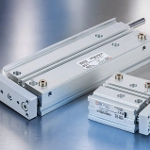 Automation-Direct has expanded its guided actuator lineup with compact 12-mm dual guide rod cylinders from Metal Work. Ideal for packaging and material handling, these double-acting cylinders feature 10-mm to 250-mm strokes, magnetic pistons, and integral sensor slots. Additionally, new durable acetal plastic silencers are now available in multiple NPT/BSPP sizes to reduce pneumatic exhaust noise.
Learn more.
Expanded injection molding capabilities
 Pexco LLC has acquired Recto Molded Products and Legacy Extrusions, expanding its capabilities in complex injection molding, tooling, assembly, and engineered thermoplastic solutions for OEM manufacturers. The Cincinnati-based companies bring more than a century of manufacturing expertise, advanced production technologies, and value-added services that strengthen Pexco's ability to support customers from product design through full-scale production. Injection molding presses ranging from 55 to 500 tons.
Learn about Pexco and its value-added manufacturing services.
Custom 3D-printed steering wheel for jet dragster
 Jet dragsters use General Electric J85 engines -- the same turbines pulled from U.S. military F5 Freedom Fighters -- mounted to a custom 26-ft chassis. The racers achieve quarter-miles in 5.5 sec, but standard metal parts can fail custom ergonomic needs. Traditional manufacturing of low-volume aluminum steering wheels demands long, 8-day lead times, high costs, and multi-piece assemblies. Larsen Motorsports solved this by replacing metal with continuous fiber 3D printing using the Markforged X7. Embedding continuous carbon fiber into an Onyx nylon matrix allowed them to target specific load paths, delivering a custom steering wheel that is stiffer, lighter, and faster to produce than aluminum.
View the video.
Application Spotlight: Light-duty ring in an air vent nozzle
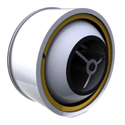 Explore how a light-duty Spirolox® retaining ring is used in an airplane air vent nozzle to regulate airflow. This application spotlight shows how the ring fits into a groove in the plastic housing, securing the nozzle during rotation. Designed for light loads and axial positioning, it offers a simple, economical solution that is easy to install and remove.
View this informative Smalley video.
Fasteners for automotive and agricultural equipment
 Norm Fasteners has acquired an automotive fastener manufacturing plant in Plymouth, MI, expanding its North American footprint beyond sales, engineering, and logistics. The local facility produces metric fasteners (M4-M24) and engine bolts. Norm’s portfolio includes wheel bolts, studs, custom fasteners, and licensed MAThread® and TAPTITE® products, serving diverse automotive and industrial assembly needs.
Learn more or contact Belgin Tunce
for more information.
3M Cooling Film for vehicle roofs launched
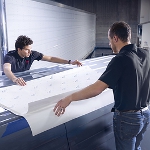 New 3M Cooling Film is a roof-applied heat-management solution designed to help keep vehicle cabins cooler, reduce cooling demand, and improve operational efficiency. The aftermarket product uses advanced thermal management technology to reflect more than 85% of solar radiation. Interior vehicle temperatures can be reduced by up to 10 degrees F with this product. Installs like graphics by professional installers using 3M adhesive technologies. Initially designed for fleet and rail operators.
Learn more.
Test your knowledge: High-temp adhesives
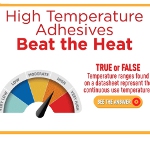 Put your knowledge to the test by trying to answer these key questions on how to choose the right high-temperature-resistant adhesive. The technical experts from Master Bond cover critical information necessary for the selection process, including questions on glass transition temperature and service temperature range. Some of the answers may surprise even the savviest of engineers.
Take the quiz.
New Air Holster Safety Air Gun Mount
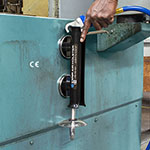 EXAIR's new Model 5930 Air Holster provides a simple and convenient way to keep Safety Air Guns secure and within easy reach at workstations throughout a facility. Designed to give operators a designated location for their air gun when not in use, the Air Holster helps prevent misplaced tools while keeping work areas organized and efficient. Its practical design makes it an ideal addition to manufacturing, assembly, maintenance, and other industrial workstations where Safety Air Guns are frequently used.
Learn more.
Southco access hardware in rail applications
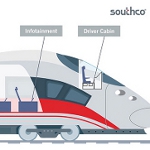 Discover how Southco's rail access hardware solutions help improve safety, reliability, and operational efficiency across modern rail networks. The video showcases a range of rail applications where Southco's access hardware plays a critical role, including driver cabins, lighting systems, tray tables, headrests, armrests, and other passenger and operator touchpoints. Designed to support dependable performance in demanding moving environments, Southco's solutions help operators streamline maintenance processes, minimize downtime, and enable more proactive asset management.
View the video.
Multi-zone tension leveler for hard-to-flatten alloys
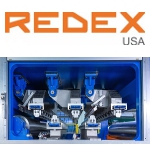 Redex USA's Levelflex® is a modular, multi-zone tension leveler engineered for continuous processing lines, including coating and heat treatment of aluminum alloys and where flatness is critical to coating adhesion and downstream formability. By stretching material within 95% of its yield strength, it corrects stubborn flatness defects in fewer passes. It comes in open-loop pure stretch or closed-loop tension measurement modes to optimize surface integrity and eliminate crossbow.
Learn more.
Hold any shape with ID and OD Form Holding Clamps
 These simple OD and ID clamping solutions from Fixtureworks clamp onto your part in one easy operation, eliminating the need for custom fixtures. They allow users to clamp onto the inner or outer diameter of small-size, irregularly shaped work parts fast. Lots of options.
Learn more.
Hot shot: U.S. Army engineers develop Solid State Active Denial Technology for non-lethal crowd control
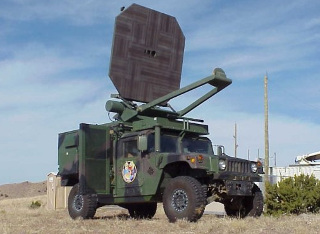
A prototype of the HMMWV Mounted Active Denial System 1. HMMWV stands for High Mobility Multipurpose Wheeled Vehicle, commonly known as the Humvee, a four-wheel drive military light truck. System 1 was successfully used in a series of land- and maritime-based military utility assessments. [Photo Credit: U.S. Army]
By Lauren Poindexter, Picatinny Arsenal
Engineers at Picatinny Arsenal in New Jersey are developing technology for non-lethal crowd control designed to help protect Soldiers while minimizing collateral damage and preventing any permanent physical harm.
The designers believe that the Solid State Active Denial Technology (SS-ADT) is highly promising for crowd dispersal, checkpoint security, perimeter security, and port protection from both mobile and fixed-site applications. Other potential applications include static defense, suppression of vehicle and vessel operators or occupants, along with critical asset protection.
"The work over the last few years resulted in a working prototype that is planned for use in Military Utility Assessments," said Thomas Shadis, chief of the Directed Energy and Non-Lethal Branch, which is part of the U.S. Armament Research, Development and Engineering Center (ARDEC).
"The team continues to work on further reducing the size, weight, and power of the technology to enable integration on tactical vehicles," Shadis said.
SS-ADT is a directed-energy weapon that uses radio frequency (RF) millimeter waves at 95 GHz traveling at the speed of light to create a brief, intolerable heating sensation on a person's skin at tactically useful ranges. The heat sensation propels people to instinctively move to escape the energy.
A Soldier is "in the loop" while operating the system, which automatically times out in a few seconds to limit exposure and renders the technology safe. The beam of RF energy created by the technology is invisible, silent, and can penetrate glass and clothing.
There is minimal risk of injury due to the shallow energy penetration, resulting in only about 1/64th of an inch into the skin. The effects begin instantaneously, causing the skin to heat quickly, reaching an intolerable effect level and forcing a response such as a flinch or flee.
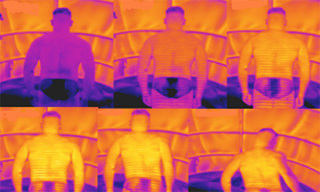
Active Denial Technology, or ADT, is the term used to describe technology that uses 95-GHz radio frequency millimeter waves to produce an intolerable heating sensation compelling targeted individuals to instinctively move out of the beam. [Photo Credit: U.S. Army]
"It feels like an intense heating sensation similar to opening an oven door and a burst of heat instinctively makes you move away," said Edward Robinson, the ARDEC project officer.
The effects stop when the adversary moves away from the beam.
According to Robinson, the technology has undergone a full legal and treaty review and is compliant with the international legal obligations of the United States. The technology is also consistent with customary international law, domestic law, and U.S. policy.
These reviews have determined there are no legal prohibitions to the development and use of this technology when used properly and in accordance with appropriate tactics, techniques, and procedures.
VIDEO: See the SS-ADT in action. Raytheon is currently marketing a reduced-range version of this technology.
Technology benefits:
- SS-ADT only requires a recharging of the battery and thermal management system (vs. gyrotrons, which require many hours for magnet cool down).
- Reduces logistics/resupply burden: existing conventional non-lethal systems require a resupply of munitions once the basic load is consumed.
- Lightweight, small footprint that is suitable for vehicle mounting or hard stand.
Published October 2016
Rate this article
View our terms of use and privacy policy