
Temp control: Adaptive tuning may address PID control needs
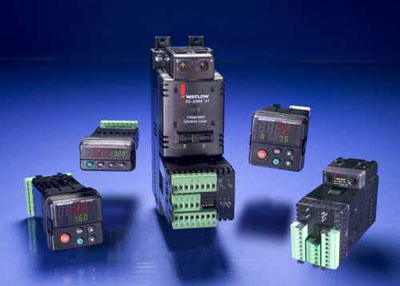
Watlow’s new EZ-ZONE ST integrated control loop, which combines multiple control functions in a single package, incorporates adaptive tuning technology. Adaptive tune, as the name indicates, adapts to the dynamics of the process and will tune “on the fly,” responding to certain process criteria as determined by the specifics of the adaptive algorithm being used. It changes the PID (proportional band, integral reset, and derivative/rate) values to respond to the change in the process.
A leading manufacturer of trailer-mounted portable decontamination systems, including heated showers, needed precise boiler temperature control for water used to decontaminate large numbers of people quickly in response to Hurricane Katrina in 2005. For this application, it was critical that the shower water temperature be maintained at precisely 92°F. If the water was too cool, the hazardous material may not have been successfully removed. If the water was too hot, people could have been scalded or the pores of their skin could have opened, increasing their exposure to the very chemicals that the process was designed to remove. The company developed three- and four-boiler trailers to increase decontamination capacity, but control of this number of boilers proved to be difficult.
Watlow’s multi-loop temperature controller with the TRU-TUNE+ adaptive algorithm was able to tune the loops automatically, minimizing setup time and effort. In addition, it was able to provide optimal performance by fine-tuning loops more precisely than auto-tune features, and provided stable control through set-point and load changes. The company’s earlier systems with more than two boilers experienced unacceptable water temperature fluctuations when showers were turned on or off. Because the system included numerous showers that could be independently turned on and off, the water flow could change quickly, and by a large volume. Prior attempts with other products failed to control this very dynamic system at a test facility. When deployed, the decontamination equipment needed to provide precise water temperature control regardless of whether the emergency happened in the blazing temperatures of New Orleans or the frigid cold of Michigan.
With the adaptive tune algorithm, the controller recognized the changing dynamics of the system and adapted on the fly while maintaining the temperature well within the customer’s specifications, even with the different inlet water temperatures and changes in flow rates.
Is adaptive tune control right for my application?
When considering whether adaptive tune control is right for an application, there are several key aspects to explore. How dynamic is the process? Are there overshoot problems? Are tighter control and increased accuracy important? Can consistent control help reduce scrap?
First, let’s look at what adaptive tune is not. Often when “Auto Tune” capabilities are mentioned, the reference is typically to “predictive tune,” where the algorithm calculates what the proportional band, integral reset, and derivative/rate (PID) values should be for the process loop to be controlled. Once the values have been set, the control of the process variable is achieved by varying only the process output percentage. As long as the process is stable, this works reasonably well.
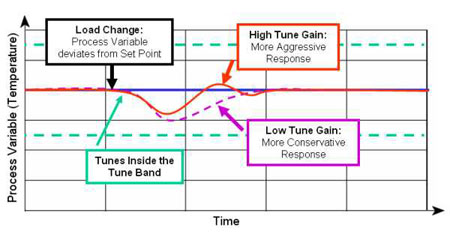
The effect of Tune Gain on recovery from a load change.
Adaptive tune defined
Adaptive tune, as the name indicates, adapts to the dynamics of the process and will tune on the fly, responding to certain process criteria as determined by the specifics of the adaptive algorithm being used. It changes the PID values to respond to the change in the process. When applied properly, it is of great value in taming hard-to-tune process loops. It will also tune a typical process loop more precisely.
Determining adaptive tune need
Adaptive control algorithms can improve tuning in virtually any process because the user no longer needs to be a tuning expert, nor do they need to call one in. Even an expert, however, cannot feasibly tune some processes, because they require re-tuning as conditions change. This is true for processes that are operated at a wide range of set points such that the PID parameter values must be different at different set points. It is also true for processes that routinely undergo load changes, such as exothermic chemical reaction or shear heat that results from a plastic extrusion process. For such processes, adaptive control will provide a better match of PID parameters that are automatically optimized.
The question often arises about whether adaptive tuning will over-tune an application. Most adaptive algorithms will not over-tune a loop, but you should ask the provider how a particular adaptive algorithm tunes. If the provider can’t explain how the tuning works or is vague, you may have to dig further to ensure the solution provides what you are looking for. The ideal situation is when the algorithm continuously monitors the process performance and adjusts the tuning only when needed.
Adaptive tune is ideal when a tuning expert is not available because it applies “built-in” expertise. All the operator must do is set up the sensor type and output type (such as time proportioning, or burst fire), set a set point, and set the control mode to tune. Then, the algorithm takes charge.
Most applications are not so dynamic that they require adaptive tuning, but virtually any process can be better tuned. The resulting PID settings will better reflect the thermal characteristics of the process.

Dave Meyer has been a regional application manager with Watlow for the past nine years. He has been in the controls industry for over 30 years, with experience ranging from PLC applications to process sensors and controls. Much of his experience has been in the field assisting customers with application consulting as well as project management.
The benefits of better tuning
When a process is well tuned, processed materials are kept closer to the target setting. This improves yield and reduces scrap and rework of mis-processed material. In addition, when the process variable tracks the set point better, the process spends less time warming up and stabilizing, so it is available and productive more of the time, which helps save capital and energy costs.
Most adaptive algorithms will work well across a range of different process types (faster or slower responding loops). A faster responding process often calls for a higher proportional value, a lower integral value, and in some cases even turning the derivative to zero. A slow responding loop will typically call for a lower proportional value and higher integral value. The adaptive tune will automatically compensate for these differences in requirements.
The bottom line — adaptive tune provides “expertise in a box.” It takes the experience of control experts and packages it in the algorithm, making it straightforward and easy for the user to implement.
While there are similarities between the different adaptive tune algorithms, they each have their differences. The following shares some insight as to how Watlow implements their adaptive tune, called TRU-TUNE+. We will look at a couple of features called “Tune Band,” and “Tune Gain,” what they mean, and what they do for users.
“Tune Band” used in this algorithm describes the process when the variable is within this band around the set point. When this occurs, TRU-TUNE+ adaptively tunes the PID parameters (see chart). When the process variable is outside this band, no tuning is performed. This prevents undesirable de-tuning of the PID parameters.
“Tune Gain” is the parameter that determines how responsive the algorithm will be to deviations from set point and set point changes. Since the responsiveness is actually a user preference dependent upon the relative importance of preventing overshoot and minimizing time-to-set-point, this parameter is not set automatically and may be changed by the operator. There are six settings ranging from 1 with the least aggressive response and least potential overshoot (lowest gain) to 6 with most aggressive response and most potential for overshoot (highest gain).
Success breeds new applications
The success of adaptive tuning has enabled the technology to be incorporated in more products that are being introduced to the market. Watlow recently announced that its new EZ-ZONE ST integrated control loop, which combines multiple control functions in a single package, incorporates adaptive tuning technology.
Technology in general has been advancing exponentially the last several years. Some changes are just that, changes with limited or no advancement. The adaptive tune functionality brings changes that provide tangible benefits to industry and ultimately the consumer by improving quality, reducing defects, and overall making products more user-friendly. Adaptive tune will help you stay in step with the latest innovations.
Want more information? Click below.
Watlow
© Nelson Publishing, Inc. All Rights Reserved