 |
| May 03, 2022 | Volume 18 Issue 17 |
Mechanical News & Products

Designfax weekly eMagazine

Archives
Partners
Manufacturing Center
Product Spotlight
Modern Applications News
Metalworking Ideas For
Today's Job Shops
Tooling and Production
Strategies for large
metalworking plants
Engineer's Toolbox: How to design the optimum hinge
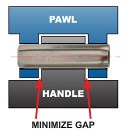 Although many pin styles are available, Coiled Spring Pins are particularly well suited for
use in both friction- and free-fit hinges. To achieve optimum long-term hinge performance,
designers should observe these helpful design guidelines from SPIROL.
Although many pin styles are available, Coiled Spring Pins are particularly well suited for
use in both friction- and free-fit hinges. To achieve optimum long-term hinge performance,
designers should observe these helpful design guidelines from SPIROL.
Read the full article.
Innovative new robo welding gun
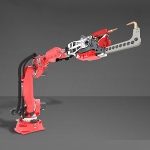 Comau's newest N-WG welding gun is designed for high-speed spot welding for traditional, hybrid, and electric vehicles, in addition to general industry sectors. It features a patented, single-body architecture that enables rapid reconfiguration between welding types and forces, and it delivers consistent performance across a broad range of applications, including steel and (soon) aluminum welding. It supports both X and C standard gun configurations, has fast arm exchange, and universal mounting options. It is fully compatible with major robot brands and represents a significant advancement in spot welding performance and cost efficiency.
Learn more.
What's a SLIC Pin®? Pin and cotter all in one!
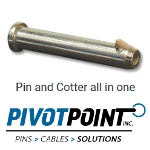 The SLIC Pin (Self-Locking Implanted Cotter Pin) from Pivot Point is a pin and cotter all in one. This one-piece locking clevis pin is cost saving, fast, and secure. It functions as a quick locking pin wherever you need a fast-lock function. It features a spring-loaded plunger that functions as an easy insertion ramp. This revolutionary fastening pin is very popular and used successfully in a wide range of applications.
Learn more.
Engineering challenge: Which 3D-printed parts will fade?
 How does prolonged exposure to intense UV light impact 3D-printed plastics? Will they fade? This is what Xometry's Director of Application Engineering, Greg Paulsen, set to find out. In this video, Paulsen performs comprehensive tests on samples manufactured using various additive processes, including FDM, SLS, SLA, PolyJet, DLS, and LSPc, to determine their UV resistance. Very informative. Some results may surprise you.
View the video.
Copper filament for 3D printing
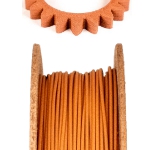 Virtual Foundry, the company that brought us 3D-printable lunar regolith simulant, says its popular Copper Filamet™ (not a typo) is "back in stock and ready for your next project." This material is compatible with any open-architecture FDM/FFF 3D printer. After sintering, final parts are 100% pure copper. Also available as pellets. The company says this is one of the easiest materials to print and sinter. New Porcelain Filamet™ available too.
Learn more and get all the specs.
Copper foam -- so many advantages
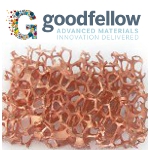 Copper foam from Goodfellow combines the outstanding thermal conductivity of copper with the structural benefits of a metal foam. These features are of particular interest to design engineers working in the fields of medical products and devices, defense systems and manned flight, power generation, and the manufacture of semiconductor devices. This product has a true skeletal structure with no voids, inclusions, or entrapments. A perennial favorite of Designfax readers.
Learn more.
Full-color 3D-printing Design Guide from Xometry
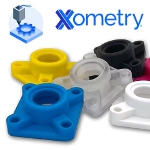 With Xometry's PolyJet 3D-printing service, you can order full-color 3D prints easily. Their no-cost design guide will help you learn about different aspects of 3D printing colorful parts, how to create and add color to your models, and best practices to keep in mind when printing in full color. Learn how to take full advantage of the 600,000 unique colors available in this flexible additive process.
Get the Xometry guide.
Tech Tip: How to create high-quality STL files for 3D prints
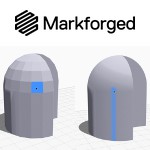 Have you ever 3D printed a part that had flat spots or faceted surfaces where smooth curves were supposed to be? You are not alone, and it's not your 3D printer's fault. According to Markforged, the culprit is likely a lack of resolution in the STL file used to create the part.
Read this detailed and informative Markforged blog.
Test your knowledge: High-temp adhesives
 Put your knowledge to the test by trying to answer these key questions on how to choose the right high-temperature-resistant adhesive. The technical experts from Master Bond cover critical information necessary for the selection process, including questions on glass transition temperature and service temperature range. Some of the answers may surprise even the savviest of engineers.
Take the quiz.
Engineer's Toolbox: How to pin a shaft and hub assembly properly
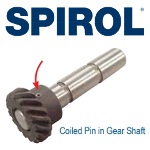 One of the primary benefits of using a coiled spring pin to affix a hub or gear to a shaft is the coiled pin's ability to prevent hole damage. Another is the coiled pin absorbs wider hole tolerances than any other press-fit pin. This translates to lower total manufacturing costs of the assembly. However, there are a few design guidelines that must be adhered to in order to achieve the maximum strength of the pinned system and prevent damage to the assembly.
Read this very informative SPIROL article.
What's new in Creo Parametric 11.0?
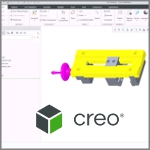 Creo Parametric 11.0 is packed with productivity-enhancing updates, and sometimes the smallest changes make the biggest impact in your daily workflows. Mark Potrzebowski, Technical Training Engineer, Rand 3D, runs through the newest functionality -- from improved surface modeling tools to smarter file management and model tree navigation. Videos provide extra instruction.
Read the full article.
What's so special about wave springs?
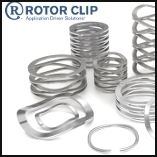 Don't settle for ordinary springs. Opt for Rotor Clip wave springs. A wave spring is a type of flat wire compression spring characterized by its unique waveform-like structure. Unlike traditional coil springs, wave springs offer an innovative solution to complex engineering challenges, producing forces from bending, not torsion. Their standout feature lies in their ability to compress and expand efficiently while occupying up to 50% less axial space than traditional compression springs. Experience the difference Rotor Clip wave springs can make in your applications today!
View the video.
New Standard Parts Handbook from JW Winco
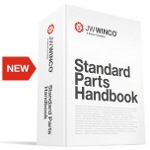 JW Winco's printed Standard Parts Handbook is a comprehensive 2,184-page reference that supports designers and engineers with the largest selection of standard parts categorized into three main groups: operating, clamping, and machine parts. More than 75,000 standard parts can be found in this valuable resource, including toggle clamps, shaft collars, concealed multiple-joint hinges, and hygienically designed components.
Get your Standard Parts Handbook today.
Looking to save space in your designs?
 Watch Smalley's quick explainer video to see how engineer Frank improved his product designs by switching from traditional coil springs to compact, efficient wave springs. Tasked with making his products smaller while keeping costs down, Frank found wave springs were the perfect solution.
View the video.
Top die casting design tips
 You can improve the design and cost of your die cast parts with these top tips from Xometry's Joel Schadegg. Topics include: Fillets and Radii, Wall Thicknesses, Ribs and Metal Savers, Holes and Windows, Parting Lines, and more. Follow these recommendations so you have the highest chance of success with your project.
Read the full Xometry article.
New technology 3D prints glass microstructures with rays of light
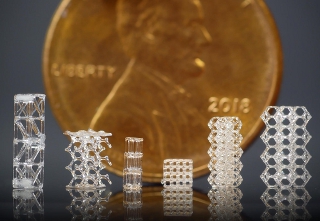
Researchers at UC Berkeley have developed a new way to 3D print glass microstructures, including these 3D-printed glass lattices, which are displayed in front of a U.S. penny for scale. [Credit: Photo by Joseph Toombs/UC Berkeley]
Researchers at UC Berkeley in California have developed a new way to 3D print glass microstructures that is faster and produces objects with higher optical quality, design flexibility, and strength, according to a new study published in the April 15 issue of the journal Science.
Working with scientists from the Albert Ludwig University of Freiburg, Germany, the researchers expanded the capabilities of a 3D-printing process they developed three years ago -- computed axial lithography (CAL) -- to print much finer features and to print in glass. They dubbed this new system "micro-CAL."
Glass is the preferred material for creating complex microscopic objects, including lenses in compact, high-quality cameras used in smartphones and endoscopes, as well as microfluidic devices used to analyze or process minute amounts of liquid. Current manufacturing methods, however, can be slow, expensive, and limited in their ability to meet industry's increasing demands.
The CAL process is fundamentally different from today's industrial 3D-printing manufacturing processes, which build up objects from thin layers of material. This technique can be time intensive and result in rough surface texture. CAL, however, 3D prints the entire object simultaneously. Researchers use a laser to project patterns of light into a rotating volume of light-sensitive material, building up a 3D light dose that then solidifies in the desired shape. The layer-less nature of the CAL process enables smooth surfaces and complex geometries.
This study pushes the boundaries of CAL to demonstrate its ability to print microscale features in glass structures. "When we first published this method in 2019, CAL could print objects into polymers with features down to about a third of a millimeter in size," said Hayden Taylor, principal investigator and professor of mechanical engineering at UC Berkeley. "Now, with micro-CAL, we can print objects in polymers with features down to about 20-millionths of a meter, or about a quarter of a human hair's breadth, and, for the first time, we have shown how this method can print not only into polymers but also into glass, with features down to about 50-millionths of a meter."
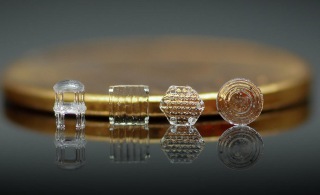
3D-printed microlens models [Credit: Photo by Joseph Toombs/UC Berkeley]
To print the glass, Taylor and his research team collaborated with scientists from the Albert Ludwig University of Freiburg, who have developed a special resin material containing nanoparticles of glass surrounded by a light-sensitive binder liquid. Digital light projections from the printer solidify the binder, then the researchers heat the printed object to remove the binder and fuse the particles together into a solid object of pure glass.
"The key enabler here is that the binder has a refractive index that is virtually identical to that of the glass, so that light passes through the material with virtually no scattering," said Taylor. "The CAL printing process and this Glassomer [GmbH]-developed material are a perfect match for each other."
The research team, which included lead author Joseph Toombs, a Ph.D. student in Taylor's lab, also ran tests and discovered that the CAL-printed glass objects had more consistent strength than those made using a conventional layer-based printing process. "Glass objects tend to break more easily when they contain more flaws or cracks, or have a rough surface," said Taylor. "CAL's ability to make objects with smoother surfaces than other, layer-based 3D-printing processes is therefore a big potential advantage."
The CAL 3D-printing method offers manufacturers of microscopic glass objects a new and more efficient way to meet customers' demanding requirements for geometry, size, and optical and mechanical properties. Specifically, this includes manufacturers of microscopic optical components, which are a key part of compact cameras, virtual reality headsets, advanced microscopes, and other scientific instruments.
"Being able to make these components faster and with more geometric freedom could potentially lead to new device functions or lower-cost products," said Taylor.
Source: UC Berkeley
Published May 2022
Rate this article
View our terms of use and privacy policy