 |
| November 08, 2022 | Volume 18 Issue 42 |
Mechanical News & Products

Designfax weekly eMagazine

Archives
Partners
Manufacturing Center
Product Spotlight
Modern Applications News
Metalworking Ideas For
Today's Job Shops
Tooling and Production
Strategies for large
metalworking plants
What's a SLIC Pin®? Pin and cotter all in one!
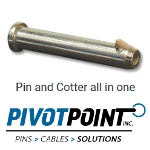 The SLIC Pin (Self-Locking Implanted Cotter Pin) from Pivot Point is a pin and cotter all in one. This one-piece locking clevis pin is cost saving, fast, and secure. It functions as a quick locking pin wherever you need a fast-lock function. It features a spring-loaded plunger that functions as an easy insertion ramp. This revolutionary fastening pin is very popular and used successfully in a wide range of applications.
Learn more.
Engineering challenge: Which 3D-printed parts will fade?
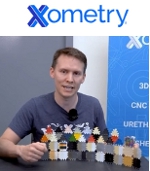 How does prolonged exposure to intense UV light impact 3D-printed plastics? Will they fade? This is what Xometry's Director of Application Engineering, Greg Paulsen, set to find out. In this video, Paulsen performs comprehensive tests on samples manufactured using various additive processes, including FDM, SLS, SLA, PolyJet, DLS, and LSPc, to determine their UV resistance. Very informative. Some results may surprise you.
View the video.
Copper filament for 3D printing
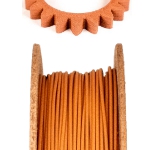 Virtual Foundry, the company that brought us 3D-printable lunar regolith simulant, says its popular Copper Filamet™ (not a typo) is "back in stock and ready for your next project." This material is compatible with any open-architecture FDM/FFF 3D printer. After sintering, final parts are 100% pure copper. Also available as pellets. The company says this is one of the easiest materials to print and sinter. New Porcelain Filamet™ available too.
Learn more and get all the specs.
Copper foam -- so many advantages
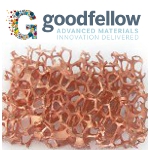 Copper foam from Goodfellow combines the outstanding thermal conductivity of copper with the structural benefits of a metal foam. These features are of particular interest to design engineers working in the fields of medical products and devices, defense systems and manned flight, power generation, and the manufacture of semiconductor devices. This product has a true skeletal structure with no voids, inclusions, or entrapments. A perennial favorite of Designfax readers.
Learn more.
Full-color 3D-printing Design Guide from Xometry
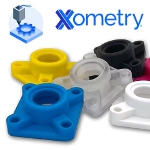 With Xometry's PolyJet 3D-printing service, you can order full-color 3D prints easily. Their no-cost design guide will help you learn about different aspects of 3D printing colorful parts, how to create and add color to your models, and best practices to keep in mind when printing in full color. Learn how to take full advantage of the 600,000 unique colors available in this flexible additive process.
Get the Xometry guide.
Tech Tip: How to create high-quality STL files for 3D prints
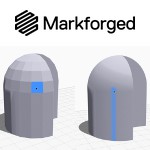 Have you ever 3D printed a part that had flat spots or faceted surfaces where smooth curves were supposed to be? You are not alone, and it's not your 3D printer's fault. According to Markforged, the culprit is likely a lack of resolution in the STL file used to create the part.
Read this detailed and informative Markforged blog.
Test your knowledge: High-temp adhesives
 Put your knowledge to the test by trying to answer these key questions on how to choose the right high-temperature-resistant adhesive. The technical experts from Master Bond cover critical information necessary for the selection process, including questions on glass transition temperature and service temperature range. Some of the answers may surprise even the savviest of engineers.
Take the quiz.
Engineer's Toolbox: How to pin a shaft and hub assembly properly
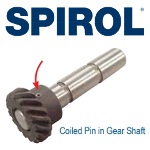 One of the primary benefits of using a coiled spring pin to affix a hub or gear to a shaft is the coiled pin's ability to prevent hole damage. Another is the coiled pin absorbs wider hole tolerances than any other press-fit pin. This translates to lower total manufacturing costs of the assembly. However, there are a few design guidelines that must be adhered to in order to achieve the maximum strength of the pinned system and prevent damage to the assembly.
Read this very informative SPIROL article.
What's new in Creo Parametric 11.0?
 Creo Parametric 11.0 is packed with productivity-enhancing updates, and sometimes the smallest changes make the biggest impact in your daily workflows. Mark Potrzebowski, Technical Training Engineer, Rand 3D, runs through the newest functionality -- from improved surface modeling tools to smarter file management and model tree navigation. Videos provide extra instruction.
Read the full article.
What's so special about wave springs?
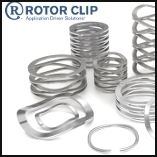 Don't settle for ordinary springs. Opt for Rotor Clip wave springs. A wave spring is a type of flat wire compression spring characterized by its unique waveform-like structure. Unlike traditional coil springs, wave springs offer an innovative solution to complex engineering challenges, producing forces from bending, not torsion. Their standout feature lies in their ability to compress and expand efficiently while occupying up to 50% less axial space than traditional compression springs. Experience the difference Rotor Clip wave springs can make in your applications today!
View the video.
New Standard Parts Handbook from JW Winco
 JW Winco's printed Standard Parts Handbook is a comprehensive 2,184-page reference that supports designers and engineers with the largest selection of standard parts categorized into three main groups: operating, clamping, and machine parts. More than 75,000 standard parts can be found in this valuable resource, including toggle clamps, shaft collars, concealed multiple-joint hinges, and hygienically designed components.
Get your Standard Parts Handbook today.
Looking to save space in your designs?
 Watch Smalley's quick explainer video to see how engineer Frank improved his product designs by switching from traditional coil springs to compact, efficient wave springs. Tasked with making his products smaller while keeping costs down, Frank found wave springs were the perfect solution.
View the video.
Top die casting design tips
 You can improve the design and cost of your die cast parts with these top tips from Xometry's Joel Schadegg. Topics include: Fillets and Radii, Wall Thicknesses, Ribs and Metal Savers, Holes and Windows, Parting Lines, and more. Follow these recommendations so you have the highest chance of success with your project.
Read the full Xometry article.
What's the latest from 3D Systems? Innovations for different industries, processes
 3D Systems unveiled several new solutions at the RAPID+TCT 2025 show in April designed to change the way industries innovate. From new 3D printers and materials for high-mix, low-volume applications to marked improvements in how investment casting can be done, learn what is the state of the art from the original inventors of 3D printing.
Read the full article.
Clever! Indexing plungers with chamfered pins
 JW Winco has developed a new type of indexing plunger -- GN 824 -- that can independently latch into edges and grooves. This is made possible by a chamfered plunger pin. When the chamfered pin encounters a raised latching geometry, it retracts and then springs back out again once it reaches the latching point. This new indexing plunger can be ordered with axial thread for fastening and a black plastic knob for operating the indexing plunger. In a clever design, the plunger pin can be adjusted by 360 degrees to ensure that it encounters the mating surface perpendicularly. This hardware is well suited for transport frames, mechanisms, or covers that need to be locked in place quickly and securely, especially without the need for manual intervention.
Learn more.
New catalyst can turn smelly hydrogen sulfide into a cash cow
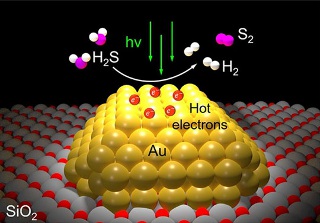
An illustration of the light-powered, one-step remediation process for hydrogen sulfide gas made possible by a gold photocatalyst created at Rice University. [Image credit: Courtesy of Halas Group/Rice University]
By Jade Boyd, Rice University
Rice University engineers and scientists have created a sweet way for petrochemical refineries to turn a smelly byproduct into cash.
Hydrogen sulfide gas has the unmistakable aroma of rotten eggs. It often emanates from sewers, stockyards, and landfills, but it is particularly problematic for refineries, petrochemical plants, and other industries that make thousands of tons of the noxious gas each year as a byproduct of processes that remove sulfur from petroleum, natural gas, coal, and other products.
In a published study in the American Chemical Society's high-impact journal ACS Energy Letters, Rice engineer, physicist, and chemist Naomi Halas and collaborators describe a method that uses gold nanoparticles to convert hydrogen sulfide into high-demand hydrogen gas and sulfur in a single step. Better yet, the one-step process gets all its energy from light.
"Hydrogen sulfide emissions can result in hefty fines for industry, but remediation is also very expensive," said Halas, a nanophotonics pioneer whose lab has spent years developing commercially viable light-activated nanocatalysts. "The phrase 'game changer' is overused, but in this case, it applies. Implementing plasmonic photocatalysis should be far less expensive than traditional remediation, and it has the added potential of transforming a costly burden into an increasingly valuable commodity."
Each molecule of hydrogen sulfide gas (H2S) contains a pair of hydrogen atoms and one atom of sulfur. Each molecule of clean-burning hydrogen gas (H2) -- the staple commodity of the hydrogen economy -- contains a pair of hydrogen atoms. In the new study, Halas' team dotted the surface of grains of silicon dioxide powder with tiny islands of gold. Each island was a gold nanoparticle about 10 billionths of a meter across that would interact strongly with a specific wavelength of visible light. These plasmonic reactions create "hot carriers," short-lived, high-energy electrons that can drive catalysis.
In the study, Halas and co-authors used a laboratory setup and showed a bank of LED lights could produce hot carrier photocatalysis and efficiently convert H2S directly into H2 gas and sulfur. That's a stark contrast to the established catalytic technology refineries use to break down hydrogen sulfide. Known as the Claus process, it produces sulfur but no hydrogen, which it instead converts into water. The Claus process also requires multiple steps, including some that require combustion chambers heated to about 1,500 F.
The plasmonic hydrogen sulfide remediation technology has been licensed by Syzygy Plasmonics, a Houston-based start-up company with more than 60 employees, whose co-founders include Halas and Nordlander.
Halas said the remediation process could wind up having low-enough implementation costs and high-enough efficiency to become economical for cleaning up nonindustrial hydrogen sulfide from sources like sewer gas and animal wastes.
"Given that it requires only visible light and no external heating, the process should be relatively straightforward to scale up using renewable solar energy or highly efficient solid-state LED lighting," she said.
On Oct. 3, Halas and Nordlander were presented the prestigious 2022 Eni Energy Transition Award in recognition of their efforts to develop efficient light-powered catalysts for industrial-scale hydrogen production.
Published November 2022
Rate this article
View our terms of use and privacy policy