 |
| December 19, 2023 | Volume 19 Issue 47 |
Designfax weekly eMagazine
Archives
Partners
Manufacturing Center
Product Spotlight
Modern Applications News
Metalworking Ideas For
Today's Job Shops
Tooling and Production
Strategies for large
metalworking plants
AI monitors conveyor tech at BMW assembly plant
An artificial intelligence-supported system monitors conveyor technology during assembly. The integrated, learning maintenance system identifies potential faults early, avoiding more than 500 minutes of vehicle assembly disruption every year.
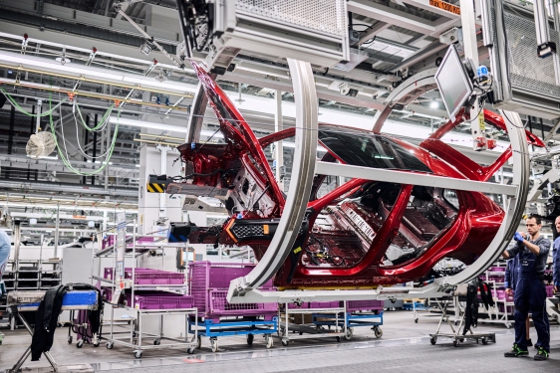
A new BMW iX2 is shown on the production line, which is highly automated and monitored by AI systems, at the BMW Group Plant in Regensburg. [Credit: BMW Group]
Preventing unplanned stoppages before they can occur is the aim of the smart analysis system being used in assembly at BMW's Group Plant in Regensburg, southeast Germany. Predictive maintenance is proactive and preventive, demonstrating key capabilities of what smart monitoring systems offer. Data-driven analyses of conveying equipment allows potential faults to be identified early and avoided, thereby maintaining optimal vehicle production flow. The artificial intelligence (AI)-supported system avoids an average of around 500 minutes of disruption per year in vehicle assembly at this singular BMW plant alone.
For assembly at BMW's Group Plant in Regensburg, vehicles are generally attached to mobile load carriers or skid systems, which pass through the production halls in a chain. Any technical fault in the state-of-the-art conveyor systems can bring assembly lines to a standstill, requiring more maintenance effort and resulting in higher costs. To prevent this from happening, the innovation team at BMW Group Plant Regensburg has developed a system that can identify potential technical defects early to avoid any lost production. The conveyor elements affected can be removed from the assembly line and repaired, away from production. The advantage is that the monitoring system does not require any additional sensors or hardware -- it evaluates existing data from installed components and conveyor element control. An alarm sounds if anomalies are found.
For example, the load carriers used to transport vehicles through assembly send various data to the carrier control system. This data is then transmitted via the carrier and plant control system to the BMW Group's own predictive maintenance cloud platform. This is where the analysis begins: The algorithm constantly searches for irregularities, such as fluctuations in power consumption, abnormalities in conveyor movements, or barcodes that are not sufficiently legible, which could trigger a malfunction. If anomalies are found, the maintenance control center receives a warning message, which it assigns to the maintenance technician on duty. "The surveillance monitors at our control center run 24/7," says the project's manager, Oliver Mrasek. "This enables us to respond quickly to any kind of fault report and take the affected vehicle out of the cycle."
Implementation: AI supported, standardized, and cost effective
Predictive maintenance is not a standalone solution, says Mrasek. The system was standardized in collaboration with the BMW Group's central shop-floor management and other plant sites to facilitate swift and straightforward rollout to other BMW Group plant locations around the world. This approach is also cost effective. "We don't need any additional sensors, so the only costs are for storage and computing power," says Mrasek.
Machine-learning models developed in-house were also implemented in the system, which uses heat maps with various color codes for different abnormalities to visualize the model's findings. "This allows us to map different fault patterns in various components and respond to them in a targeted manner," says Mrasek.
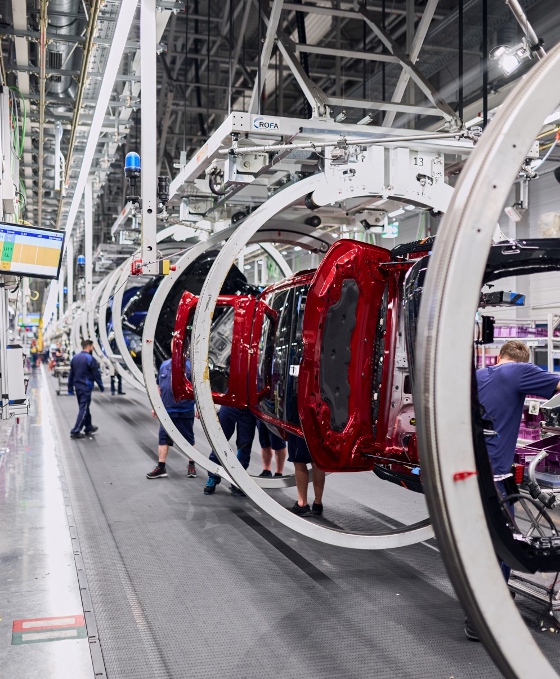
AI monitors the load carriers used to transport vehicles through assembly, sending data to the carrier control system. [Credit: BMW Group]
Based on these practical findings, the algorithms are continuously improved and refined. The team is currently in the process of connecting additional installations, optimizing the system, and integrating recommended actions into fault messages. The fault message could, for example, indicate similar problems that have occurred in a system. This simplifies troubleshooting for maintenance technicians -- for example, if an impeller on the conveyor trolley is defective. "Optimal predictive maintenance not only saves us money, it also means we can deliver the planned quantity of vehicles on time, which saves a huge amount of stress in production," explains Deniz Ince, the team's data scientist.
The next goal: Even better predictability
Mrasek and his colleagues have been working on data-driven monitoring of conveyor technology for the past six years. Today, around 80% of the main assembly lines are monitored this way. "We can't detect or prevent every single fault in advance, of course, but we are currently avoiding at least 500 minutes of downtime per year in vehicle assembly alone," he says. It is easy to calculate the savings. At BMW Group Plant Regensburg, a vehicle rolls off the assembly line roughly every minute -- every 57 seconds, to be exact -- and the system is already being used in conveyor systems at the plant sites in Dingolfing, Leipzig, and Berlin.
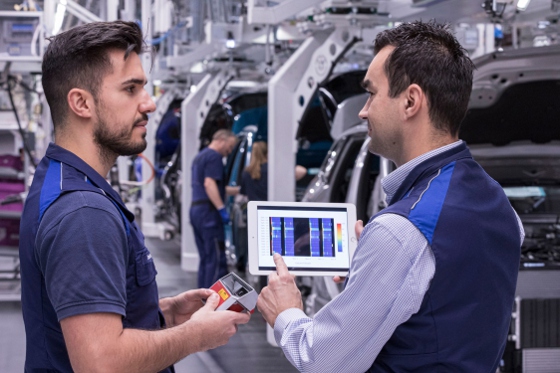
The AI-enabled predictive maintenance system was standardized and rolled out to other BMW Group plant locations around the world. [Credit: BMW Group]
The aim is to exploit the possibilities of artificial intelligence further, with the system learning to estimate how much time remains between detection of the fault and the potential stoppage. This would help technicians decide how soon they need to perform maintenance and allow them to prioritize next steps, if needed. Mrasek also sees further potential in other areas of the plant. "We are currently testing whether we can also use the system for the equipment used to fill our vehicles with brake fluid and coolant, for example," he says.
Although there are already numerous options for predictive equipment maintenance, Regensburg's integrated learning system is, so far, the first of its kind. Compatibility with predictive maintenance is therefore already being written into tenders for new conveyor technology. Equipment manufacturers are also praising the system, since they benefit from its evaluations as well. The BMW Group has already registered two patents for its in-house development.
Source: BWM Group
Published December 2023
Rate this article
View our terms of use and privacy policy