 |
| May 21, 2024 | Volume 20 Issue 19 |
Designfax weekly eMagazine
Archives
Partners
Manufacturing Center
Product Spotlight
Modern Applications News
Metalworking Ideas For
Today's Job Shops
Tooling and Production
Strategies for large
metalworking plants
Air Force uses new process to make rocket engines
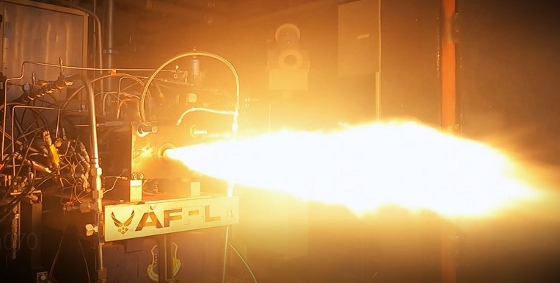
The U.S. Air Force Research Laboratory printed a first-ever, single-block rocket-engine thrust chamber using a 3D-printing process called laser powder directed energy deposition. The hot-fire test of the thrust chamber is shown in the Experimental Cell 1 (EC-1) at the AFRL Rocket Lab. [Credit: U.S. Air Force photo]
By Joy Alich, U.S. Air Force Research Laboratory
The Air Force Research Laboratory (AFRL) Rocket Propulsion Division recently designed, printed, built, and hot-fired a first-ever, single-block rocket-engine thrust chamber additively manufactured using a new process called laser powder directed energy deposition (DED).
"AFRL's investments in early advanced manufacturing techniques enable us to exploit corners of the design space for rocket engines and enable faster design turnover cycles from a concept in a whiteboard to test and evaluation in the field," said Dr. Javier Urzay, chief, Combustion Devices Branch.
DED is an additive manufacturing process in which a machine injects metal powder into focused beams of a high-power laser in highly controlled atmospheric conditions. "It provides the largest build box volume for thruster hardware to date, capable of printing seven-foot-tall parts" said Urzay. "This build box volume is much larger than that obtainable with techniques like the laser powder bed fusion, or LPBF, process. In addition, DED enables an order of magnitude less investment in powder and less material waste. Engineers can also realize alloy blending and transitions in real time for multi-alloy builds to exploit the strength, weight, and performance gains of next-generation superalloys."
VIDEO: AFRL additively manufactured rocket engines. [Credit: AFRL]
"These unique capabilities allow us to tackle complex engine designs requiring fewer iterations and leveraging shape optimization, lightweight materials, advanced metal alloys and composites, and rapid manufacturing," Urzay added.
The AFRL Rocket Propulsion Division, a component of the Aerospace Systems Directorate, is working alongside the U.S. space industry to embed these advanced additive manufacturing processes into robust digital engineering environments.
Additive manufacturing works closely with the transition from traditional ways of manufacturing rocket-engine hardware to automated manufacturing processes fed by digital environments involving artificial intelligence, machine learning, digital twins, 3D volumetric scanners, and computer aided design (CAD).
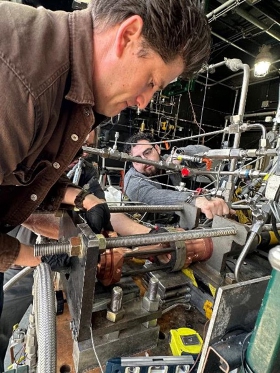
Edgar Felix, AFRL lead investigator (front), and Isaiah Jaramillo, mechanical specialist, work on the first-ever, single-block rocket-engine thrust chamber additively manufactured using DED. [Credit: U.S. Air Force photo]
The multifaceted nature of the digital environment is necessary to manage the printers that produce lightweight thrust chambers, manifolds, injectors, pressure vessels, valves, and turbomachinery blades with 3D shapes and internal features that are not easily achievable using traditional methods.
"While additive manufacturing offers many opportunities for accelerated production at lower costs, several challenges remain in the way of making this technology widely adopted by the rocket-propulsion industry and government laboratories," said Edgar Felix, aerospace engineer at the Combustion Devices Branch.
AFRL is addressing the unique challenges of producing materials that can withstand the harsh environments in which rocket engines must perform.
AFRL experts combine decades of rocket combustion chamber experience with insights into the challenges and opportunities of these new manufacturing techniques and maintain close collaborations with several external organizations that bring unique skills to the table.
"This latest breakthrough in additive manufacturing for rocket engines in our branch is one in a series that has been made possible only by forging long-lasting relationships across multiple industrial partners and government organizations, including the AFRL Materials and Manufacturing Directorate and NASA Marshall Space Flight Center," Urzay said. "Their work is extremely valuable for the nation, and together we are an unstoppable team."
The AFRL Rocket Propulsion Division continues to work on novel techniques for additive manufacturing with the goal of surging capacity in both liquid rocket engines and solid rocket motors.
Want to see DED additive manufacturing in action? This video from DED machine maker AddUp (not related to the DED efforts profiled in this AFRL story), will give you a better view into how the technology works.
VIDEO: Directed Energy Deposition. [Credit: AddUp]
Published May 2024
Rate this article
View our terms of use and privacy policy