 |
| May 28, 2024 | Volume 20 Issue 20 |
Designfax weekly eMagazine

Archives
Partners
Manufacturing Center
Product Spotlight
Modern Applications News
Metalworking Ideas For
Today's Job Shops
Tooling and Production
Strategies for large
metalworking plants
Ultra-high-temp-resistant aluminum alloy created for aerospace
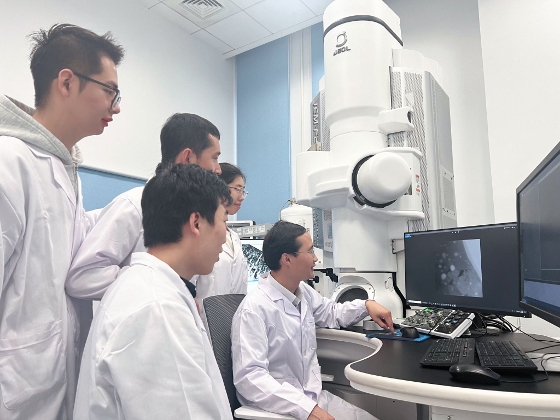
Tianjin University's Professor He Chunnian with his research group at the lab. [Credit: Tianjin University]
A research team at Tianjin University in China says it has created an oxide-dispersion-strengthened aluminum super alloy -- a breakthrough that extends the material's service temperature range from 350 to 500 degrees Celsius. It addresses the longstanding challenge of utilizing aluminum alloys in environments surpassing 400 C for aerospace applications and more.
The team's findings were published in the journal Nature Materials. The paper presents "a strategy to achieve oxide-dispersion-strengthened (ODS) Al alloys containing highly dispersive 5-nm MgO nanoparticles by powder metallurgy, using nanoparticles that have in situ-grown graphene-like coatings and hence largely reduced surface energy."
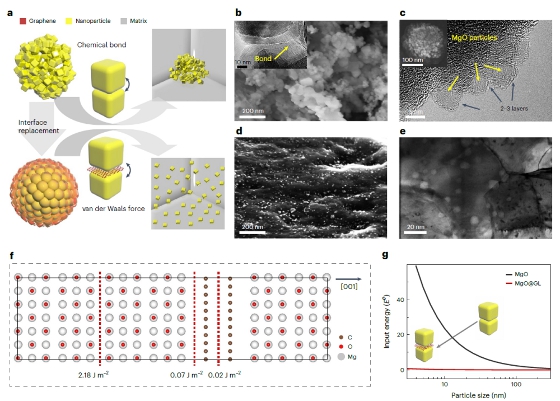
The new aluminum alloy was created using a uniform dispersion of oxide nanoparticles in the aluminum matrix. [Credit: Tianjin University]
Industries such as aerospace and transportation have a pronounced need for increased speed and reduced weight, placing greater emphasis on the heat resistance of lightweight metal materials. While aluminum alloys boast advantages like low density, high specific strength, and corrosion resistance, their limited heat resistance within the critical temperature range of 350 to 500 C poses a significant challenge, especially in aerospace applications. This makes ongoing progress in the research and development of high-performance, heat-resistant aluminum alloys that are specifically tailored for temperatures spanning from 350 to 500 C important.
To tackle this obstacle, the research team, led by Professor He Chunnian from Tianjin University's School of Materials Science and Engineering, introduced high-density, ultrafine-sized, uniformly dispersed magnesium oxide nanoparticles into the aluminum alloy, successfully enhancing its high-temperature resistance. Their innovative approach in material preparation addressed the persistent challenge of nanoparticle dispersion. As a result, the newly engineered aluminum alloy demonstrated a remarkable tensile strength exceeding 200 megapascals at 500 C, surpassing traditional aluminum alloys by more than six times, and achieving a significant enhancement in high-temperature stability spanning several orders of magnitude.
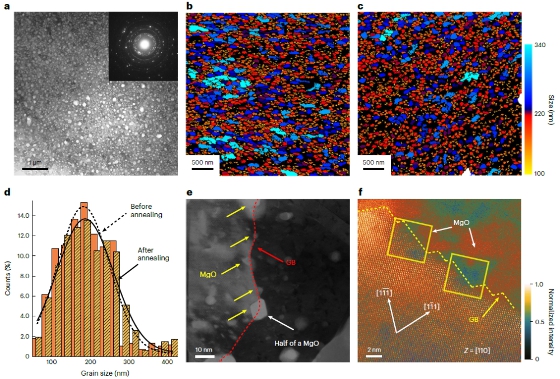
The new aluminum alloy exhibited outstanding thermal stability. [Credit: Tianjin University]
This material "shows truly outstanding properties," said Professor Alexis Deschamps, a renowned international expert in metallic materials from Universite Grenoble Alpes in France. "At 500 C, the MgO/Al alloy remains at a tensile strength of 200 MPa and has very impressive creep properties, which clearly override the state of the art."
The development opens a field for application of aluminum alloys in high-temperature environments where they could compete, at lower weight, with some titanium alloys, added Deschamps, and the novel process is straightforward, cost effective, and easy for mass production.
Deschamps said the team is partnering with prominent industry leaders and research institutions to drive forward the development of heat-resistant aluminum alloys tailored for aerospace engines and critical aerospace components, and he expected the material to be put to industrial use in the near future.
Source: Tianjin University
Published May 2024
Rate this article
View our terms of use and privacy policy