 |
| May 22, 2012 | Volume 08 Issue 20 |
Materials News & Products
Designfax weekly eMagazine

Archives
Partners
Manufacturing Center
Product Spotlight
Modern Applications News
Metalworking Ideas For
Today's Job Shops
Tooling and Production
Strategies for large
metalworking plants
How to master metal powder management in 3D printing
 What's the real cost of "good enough" powder tracking for powder-bed fusion 3D-printing machines? According to Tim Wischeropp, CEO and Co-Founder of amsight, the technology is rife with hidden costs. Every cycle, every handling step, every exposure, and every mixing decision plays a part. Surprisingly, though, with the right strategy, users can turn their losses into a competitive edge. Learn how.
Read the full article.
Aluminum oxide filament for FDM printers
 Virtual Foundry, the company that brought us 3D-printable lunar regolith simulant, has a new product called Aluminum Oxide Filamet™, giving users the power to print alumina parts using the FDM printers they already own. This composite 3D-printing material allows researchers, engineers, and makers to bypass expensive ceramic tooling and produce pure ceramic components in-house. Print using a 0.6-mm hardened-steel, standard-flow nozzle on virtually any open-architecture printer.
Get all the material specs.
DURACON polymer with 30% recycled content
Daicel Corporation's High Performance Polymers SBU has launched four new DURACON® POM grades featuring 30% post-consumer recycled (PCR) content. Unveiled at CHINAPLAS 2026, the lineup includes Standard, Low VOC, Sliding, and Tough options. Leveraging advanced compounding expertise, Daicel maintains quality and mechanical performance comparable to standard virgin resin grades for demanding global industrial and automotive components.
Learn more.
Radio Flyer cuts ebike prototype time radically with Fuse X1 large-format SLS 3D printer
Radio Flyer cut prototype lead times for its Flyer Loop cargo ebike frame from two months to two days using Formlabs' new Fuse X1 SLS large-format 3D printer. "We can now print an entire Flyer Loop cargo ebike overnight and be gluing it together the next day," said Agostino LoBello, product development engineer at Radio Flyer. "I can iterate three times as often with nine times less labor." The Fuse X1 delivers production-quality parts with 50% lower costs and triple the throughput of comparable industrial systems, featuring automated powder handling and a compact, easy-to-install design. [Credit: Image courtesy of Formlabs]
View the video.
Compact industrial sand 3D printer
ExOne has launched the S-Print Pro, a compact industrial sand 3D printer that brings production-grade binder jetting to smaller foundries, pattern shops, and print service providers. Aimed at businesses competing on cost and flexibility, it handles low-volume casting, spare parts, and custom components. The system processes furan binder with silica sand, CeraBeads, or silicon carbide.
Learn more about this capable machine.
Fast-cure composite for aero and defense manufacturing
Toray Composite Materials America has launched 3960-FC, a fast-cure variant of its high-performance 3960 prepreg system for mission-critical aerospace and defense applications. This material reduces cure time by up to 45% while maintaining proven mechanical performance, stiffness, and exceptional toughness. It is highly compatible with automated manufacturing technologies like AFP and ATL, as well as traditional processing methods.
Learn more.
Metal finishing: With rising carbide prices, when cermet makes sense
As critical raw material access tightens, manufacturers are rethinking cutting tool usage. While essential, carbide is often unnecessary for finishing processes. Cermet -- a ceramic-metal composite -- offers an excellent alternative, delivering exceptional fracture and wear resistance for these specific machining stages.
Read the full article.
Full-color 3D-printing Design Guide from Xometry
With Xometry's PolyJet 3D-printing service, you can order full-color 3D prints easily. Their no-cost design guide will help you learn about different aspects of 3D printing colorful parts, how to create and add color to your models, and best practices to keep in mind when printing in full color. Learn how to take full advantage of the 600,000 unique colors available in this flexible additive process.
Get the Xometry guide.
Next-gen SLA materials rival traditional thermoplastics
Formlabs has announced two new SLA materials that bring 3D printing significantly closer to being a manufacturing method for end-use part production. Tough 1000 Resin and a significantly improved Tough 2000 Resin join Tough 1500 Resin, forming the new Tough Resin family. These resilient engineering materials stand up to harsh environments, impact, and repeated wear, all while delivering a dark, matte surface finish with crisp details when printed on Form 4 Series 3D printers.
Learn more.
Surface inspection: From Army depot to factory floor
Born from U.S. Army requirements for rotorcraft inspection, the GelSight Modulus 3D surface measurement system has surpassed 100 units sold to commercial and Department of Defense customers. The handheld, micron-scale tool with interchangeable probe tips delivers fast, high-res measurements in places traditional tools can't reach.
Read the full article.
What is Cold Metal Fusion?
Cold Metal Fusion is an open industry standard for sinter-based metal additive manufacturing. It combines polymer SLS design freedom with reliable debinding and sintering workflows, enabling complex geometries, lightweighting, lattice structures, conformal cooling channels, and high-precision metal parts with predictable shrink behavior. Now available from TriMech Group, this process offers a faster, cost-effective way to produce strong, high-performance metal parts.
Learn more from TriMech Group.
Metal 3D printing: EOS adds four new materials
Industrial 3D-printing supplier EOS has added four new metal additive manufacturing materials to its portfolio: an iron-nickel alloy that boasts stability under fluctuating temps, a nickel alloy with high strength and extreme corrosion resistance, a low-alloyed steel prized for its high toughness and strength, and an industrial-grade stainless steel. Each has been optimized for EOS Laser Powder Bed Fusion systems.
Get all the details.
New materials and finishes from Quickparts
Quickparts has introduced DuraKor, ThermaKor, and vapor smoothing to expand its production-capable materials and finishing portfolio. The new plastics provide polypropylene-like toughness, chemical resistance, and high-temperature stability, while vapor smoothing improves sealing and surface quality. Together, these capabilities help engineers validate designs, refine performance, and transition efficiently from prototypes to scalable manufacturing.
Learn more.
What's the latest in SLA 3D printing?
Learn about the latest offerings in SLA printing from 3D Systems, including the introduction of SLA 825 Dual, the company's most advanced large-frame Stereolithography printer. Other new products include ArrayCast investment casting software that allows users to effortlessly create customized casting trees (complete with configurable runners, sprues, and end effectors), Accura SbF (the latest SLA casting resin), and Accura Xtreme Black (which delivers low shrinkage, large, functional SLA prototype parts with sharp detail).
Learn about all the new 3D Systems products.
meviy cuts CNC milling lead times to just 4 days
meviy, the on-demand custom parts manufacturing service developed by MISUMI Group, has upgraded its Expedite+ service with improved lead times for CNC Milled parts. Customers can now have their parts shipped in as few as four days through meviy's fastest delivery option. The enhanced service helps manufacturers and engineers stay on schedule when projects are behind or production is interrupted. Supported materials include steels and aluminums. Check out their instant quoting too.
Learn more.
Nanotube 'sponge' has great potential in oil-spill cleanup
A carbon nanotube sponge that can soak up oil in water with unparalleled efficiency has been developed with help from computational simulations performed at the Department of Energy's (DOE's) Oak Ridge National Laboratory (ORNL).
Carbon nanotubes, which consist of atom-thick sheets of carbon rolled into cylinders, have captured scientific attention in recent decades because of their high strength, potential high conductivity, and light weight. But producing nanotubes in bulk for specialized applications was often limited by difficulties in controlling the growth process as well as dispersing and sorting the produced nanotubes.
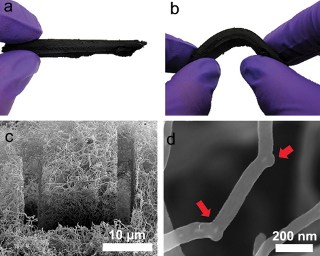
A carbon nanotube sponge developed with help from ORNL researchers holds potential as an aid for oil-spill cleanup. Simulations at ORNL explained how the addition of boron atoms encouraged the formation of "elbow" junctions (seen in d) that help the nanotubes grow into large spongelike clumps (seen in a-c). The material is extremely efficient at absorbing oil in contaminated seawater because it attracts oil and repels water.
ORNL's Bobby Sumpter was part of a multi-institutional research team that set out to grow large clumps of nanotubes by selectively substituting boron atoms into the otherwise pure carbon lattice. Sumpter and Vincent Meunier, now of Rensselaer Polytechnic Institute, conducted simulations on supercomputers, including Jaguar at ORNL's Leadership Computing Facility, to understand how the addition of boron would affect the carbon nanotube structure.
"Any time you put a different atom inside the hexagonal carbon lattice, which is a chicken wire-like network, you disrupt that network because those atoms don't necessarily want to be part of the chicken wire structure," Sumpter says. "Boron has a different number of valence electrons, which results in curvature changes that trigger a different type of growth."
Simulations and lab experiments showed that the addition of boron atoms encouraged the formation of so-called "elbow" junctions that help the nanotubes grow into a 3-D network. The team's results are published in Nature Scientific Reports.
"Instead of a forest of straight tubes, you create an interconnected, woven sponge-like material," Sumpter says. "Because it is interconnected, it becomes three-dimensionally strong, instead of only one-dimensionally strong along the tube axis."
Further experiments showed the team's material, which is visible to the human eye, is extremely efficient at absorbing oil in contaminated seawater because it attracts oil and repels water.
"It loves carbon because it is primarily carbon," Sumpter says. "Depending on the density of oil to water content and the density of the sponge network, it will absorb up to 100 times its weight in oil."
The material's mechanical flexibility, magnetic properties, and strength lend it additional appeal as a potential technology to aid in oil-spill cleanup, Sumpter says.
"You can reuse the material over and over again because it's so robust," he says. "Burning it does not substantially decrease its ability to absorb oil, and squeezing it like a sponge doesn't damage it either."
The material's magnetic properties, caused by the team's use of an iron catalyst during the nanotube growth process, means it can be easily controlled or removed with a magnet in an oil cleanup scenario. This ability is an improvement over existing substances used in oil removal, which are often left behind after cleanup and can degrade the environment.
The experimental team has submitted a patent application on the technology through Rice University. The research is published as "Covalently bonded three-dimensional carbon nanotube solids via boron induced nanojunctions," and is available online here.
The research team included researchers from ORNL, Rice University; Universidade de Vigo, Spain; Rensselaer Polytechnic Institute; University of Illinois at Urbana-Champaign; Instituto de Microelectronica de Madrid, Spain; Air Force Office of Scientific Research Laboratory; Arizona State University; Universite Catholique de Louvain, Belgium; The Pennsylvania State University; and Shinshu University, Japan.
The work was supported by the National Science Foundation, the U.S. Air Force Office of Scientific Research, the U.S. Army Research Laboratory, and by the DOE Office of Science through ORNL's Center for Nanophase Materials Sciences (CNMS) and the laboratory's Leadership Computing Facility.
Source: ORNL
Published May 2012
Rate this article
View our terms of use and privacy policy