 |
| January 07, 2025 | Volume 21 Issue 01 |
Mechanical News & Products

Designfax weekly eMagazine

Archives
Partners
Manufacturing Center
Product Spotlight
Modern Applications News
Metalworking Ideas For
Today's Job Shops
Tooling and Production
Strategies for large
metalworking plants
What's a SLIC Pin®? Pin and cotter all in one!
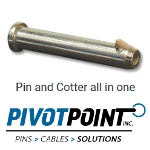 The SLIC Pin (Self-Locking Implanted Cotter Pin) from Pivot Point is a pin and cotter all in one. This one-piece locking clevis pin is cost saving, fast, and secure. It functions as a quick locking pin wherever you need a fast-lock function. It features a spring-loaded plunger that functions as an easy insertion ramp. This revolutionary fastening pin is very popular and used successfully in a wide range of applications.
Learn more.
Engineering challenge: Which 3D-printed parts will fade?
 How does prolonged exposure to intense UV light impact 3D-printed plastics? Will they fade? This is what Xometry's Director of Application Engineering, Greg Paulsen, set to find out. In this video, Paulsen performs comprehensive tests on samples manufactured using various additive processes, including FDM, SLS, SLA, PolyJet, DLS, and LSPc, to determine their UV resistance. Very informative. Some results may surprise you.
View the video.
Copper filament for 3D printing
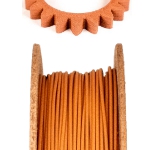 Virtual Foundry, the company that brought us 3D-printable lunar regolith simulant, says its popular Copper Filamet™ (not a typo) is "back in stock and ready for your next project." This material is compatible with any open-architecture FDM/FFF 3D printer. After sintering, final parts are 100% pure copper. Also available as pellets. The company says this is one of the easiest materials to print and sinter. New Porcelain Filamet™ available too.
Learn more and get all the specs.
Copper foam -- so many advantages
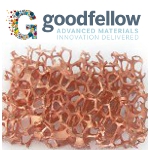 Copper foam from Goodfellow combines the outstanding thermal conductivity of copper with the structural benefits of a metal foam. These features are of particular interest to design engineers working in the fields of medical products and devices, defense systems and manned flight, power generation, and the manufacture of semiconductor devices. This product has a true skeletal structure with no voids, inclusions, or entrapments. A perennial favorite of Designfax readers.
Learn more.
Full-color 3D-printing Design Guide from Xometry
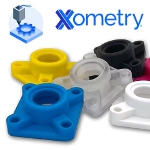 With Xometry's PolyJet 3D-printing service, you can order full-color 3D prints easily. Their no-cost design guide will help you learn about different aspects of 3D printing colorful parts, how to create and add color to your models, and best practices to keep in mind when printing in full color. Learn how to take full advantage of the 600,000 unique colors available in this flexible additive process.
Get the Xometry guide.
Tech Tip: How to create high-quality STL files for 3D prints
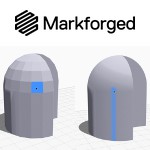 Have you ever 3D printed a part that had flat spots or faceted surfaces where smooth curves were supposed to be? You are not alone, and it's not your 3D printer's fault. According to Markforged, the culprit is likely a lack of resolution in the STL file used to create the part.
Read this detailed and informative Markforged blog.
Test your knowledge: High-temp adhesives
 Put your knowledge to the test by trying to answer these key questions on how to choose the right high-temperature-resistant adhesive. The technical experts from Master Bond cover critical information necessary for the selection process, including questions on glass transition temperature and service temperature range. Some of the answers may surprise even the savviest of engineers.
Take the quiz.
Engineer's Toolbox: How to pin a shaft and hub assembly properly
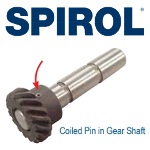 One of the primary benefits of using a coiled spring pin to affix a hub or gear to a shaft is the coiled pin's ability to prevent hole damage. Another is the coiled pin absorbs wider hole tolerances than any other press-fit pin. This translates to lower total manufacturing costs of the assembly. However, there are a few design guidelines that must be adhered to in order to achieve the maximum strength of the pinned system and prevent damage to the assembly.
Read this very informative SPIROL article.
What's new in Creo Parametric 11.0?
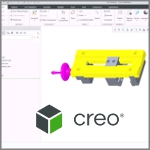 Creo Parametric 11.0 is packed with productivity-enhancing updates, and sometimes the smallest changes make the biggest impact in your daily workflows. Mark Potrzebowski, Technical Training Engineer, Rand 3D, runs through the newest functionality -- from improved surface modeling tools to smarter file management and model tree navigation. Videos provide extra instruction.
Read the full article.
What's so special about wave springs?
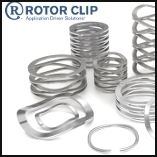 Don't settle for ordinary springs. Opt for Rotor Clip wave springs. A wave spring is a type of flat wire compression spring characterized by its unique waveform-like structure. Unlike traditional coil springs, wave springs offer an innovative solution to complex engineering challenges, producing forces from bending, not torsion. Their standout feature lies in their ability to compress and expand efficiently while occupying up to 50% less axial space than traditional compression springs. Experience the difference Rotor Clip wave springs can make in your applications today!
View the video.
New Standard Parts Handbook from JW Winco
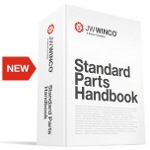 JW Winco's printed Standard Parts Handbook is a comprehensive 2,184-page reference that supports designers and engineers with the largest selection of standard parts categorized into three main groups: operating, clamping, and machine parts. More than 75,000 standard parts can be found in this valuable resource, including toggle clamps, shaft collars, concealed multiple-joint hinges, and hygienically designed components.
Get your Standard Parts Handbook today.
Looking to save space in your designs?
 Watch Smalley's quick explainer video to see how engineer Frank improved his product designs by switching from traditional coil springs to compact, efficient wave springs. Tasked with making his products smaller while keeping costs down, Frank found wave springs were the perfect solution.
View the video.
Top die casting design tips
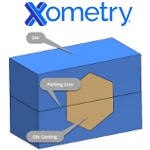 You can improve the design and cost of your die cast parts with these top tips from Xometry's Joel Schadegg. Topics include: Fillets and Radii, Wall Thicknesses, Ribs and Metal Savers, Holes and Windows, Parting Lines, and more. Follow these recommendations so you have the highest chance of success with your project.
Read the full Xometry article.
What's the latest from 3D Systems? Innovations for different industries, processes
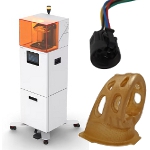 3D Systems unveiled several new solutions at the RAPID+TCT 2025 show in April designed to change the way industries innovate. From new 3D printers and materials for high-mix, low-volume applications to marked improvements in how investment casting can be done, learn what is the state of the art from the original inventors of 3D printing.
Read the full article.
Clever! Indexing plungers with chamfered pins
 JW Winco has developed a new type of indexing plunger -- GN 824 -- that can independently latch into edges and grooves. This is made possible by a chamfered plunger pin. When the chamfered pin encounters a raised latching geometry, it retracts and then springs back out again once it reaches the latching point. This new indexing plunger can be ordered with axial thread for fastening and a black plastic knob for operating the indexing plunger. In a clever design, the plunger pin can be adjusted by 360 degrees to ensure that it encounters the mating surface perpendicularly. This hardware is well suited for transport frames, mechanisms, or covers that need to be locked in place quickly and securely, especially without the need for manual intervention.
Learn more.
Can golf ball dimple tech help rockets fly better?
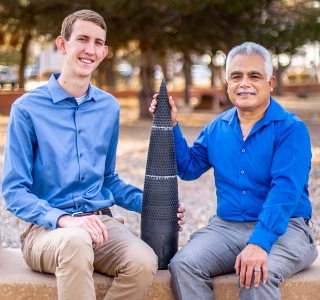
Graham Monroe, left, and Sal Rodriguez display the dimpled rocket nose they built as part of a collaboration between Sandia and the University of New Mexico. [Credit: Photo by Jennifer Plante]
Sal Rodriguez, a nuclear engineer at Sandia National Laboratories, is forging a rocket revolution with the help of the University of New Mexico and student Graham Monroe.
Their cutting-edge research is propelling the future of aerospace by infusing rocket science with a touch of golf ball magic.
They incorporated dimples similar to those found on golf balls, a key element in Rodriguez's fluid dynamics and heat transfer research.
The making of the rocket nose
The idea started in 2019 when Monroe was working with Rodriguez at Sandia as a student intern.
"I was always interested in aerodynamics," Monroe said. "I was working on my bachelor's in engineering degree in 2019 when I took part in the Lobo Launch at the Spaceport America Cup. Meanwhile, Sal was researching some dimpling projects. We started talking and came up with the idea of dimpling the nose cone of a rocket."
The experiment turned into Monroe's master's thesis project.
They started with the dimpling program that Rodriguez created starting in 2014 and copyrighted in 2017.
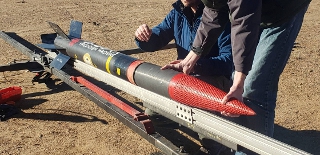
The dimpled rocket created by Sal Rodriguez and Graham Monroe was tested in December of 2022. [Credit: Photo courtesy of Sal Rodriguez]
"The program includes a specific set of equations that allows the user to look at an object's geometry and add the velocity and the fluid it's traveling through," Rodriguez said. "You put that into the program, and it outputs the required dimple pattern."
Monroe then 3D printed the nose cone. UNM's Lobo Launch team, meanwhile, created the accompanying rocket and a smooth nose cone that was identical, minus the dimples.
Due to the COVID-19 pandemic, and the fact that the Lobo Launch team needed their rocket for the upcoming Spaceport America Cup competition, launching the rocket became a challenge.
It was finally put to the test in November and December of 2022.
"We were overjoyed when we found that the dimpled rocket had 22% less frictional drag compared to a smooth rocket," Rodriguez said. "At its peak, it reduced drag by 39.1%. So that's less fuel you need, and it produces less CO2, which is good for the environment."
Monroe successfully defended his thesis in the fall of 2023, earning the coveted "pass with distinction."
"It's been really neat to be part of this research," Monroe said. "To be part of something that could be used in the real world. When we look at the day and age that we are in, as far as space exploration, the effect this could have on energy savings is really significant."
How dimples work
So how do these dimples work?
"They generate turbulence, redistribute the turbulent energy, accelerate the flow in the dimpled regions, and reduce the boundary layer thickness," Rodriguez said.
He said a good analogy is an Olympic diving competition: "The diver who plunges into the water with the smallest splash gets extra points because only a very small amount of resultant water flow is generated by the more aerodynamic dive. The same occurs with dimples. They generate a flow pattern that is so aerodynamic that only small, disorderly flow currents are generated by the dimpled objects -- a gold medal dive."
Bring in the Mustang
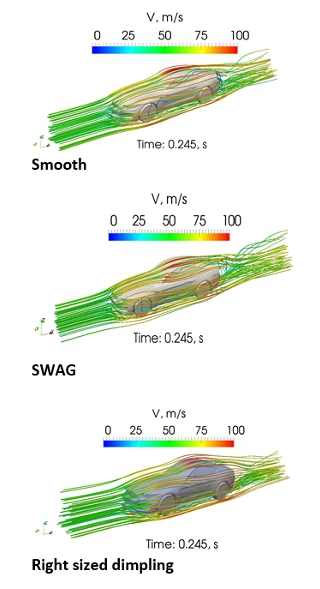
Computer simulation shows how dimples affect drag. [Credit: Courtesy of Sal Rodriguez]
However, it's not just rockets that can benefit from this dimpling. Rodriguez has been exploring other ways to use dimples. In a little-known project with Bobby Unser Junior, he dimpled the hood of a Ford Mustang.
"It was so exciting because he was so enthused about racing and race cars," Rodriguez said of Unser. "I told him about my copyright and that I could dimple his sports car and make it go faster. He was very excited."
Rodriguez used his program to find the ideal size and placement of the dimples on the car's hood. Like the rocket, the results were significant. They showed a minimum 25% reduction in airflow drag compared to a car with no dimples. The experiment also included a car with tennis ball-sized dimples to prove that while all dimpling helps, precision with dimples is key.
Whether consumers would be okay with dimples on their car was another question the pair hoped to explore. Unfortunately, Unser died before the project went any further.
It's not just in aerodynamics
One of Rodriguez's latest projects is using dimples in heat transfer.
With the help of funding from the New Mexico Small Business Assistance Program, he has built an apparatus that shows how dimples can speed up the heating process.
A box with three sides of plexiglass and one side of dimpled aluminum is filled with water and then connected to a heat source.
"We put beads and dye in there to see how they move along the dimples," Rodriguez said. "We witnessed them accelerate, twice the velocity than outside the dimple area, and with increased turbulence." That proves that the dimpling enhances heat transfer.
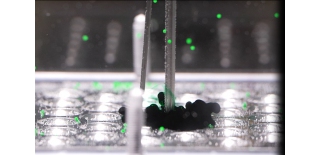
Click this thumbnail to watch a heat transfer experiment using dimples. [Credit: Sandia]
Rodriguez says this technology can be transformed into a solar water heater. That could be life-changing for places that don't have easy access to electricity, such as Indian reservations or developing nations. It has already caught the attention of a company in another country.
The road ahead
Rodriguez's dimpling work is far from done. His team recently submitted a non-provisional patent application for dimpled wind turbines.
"We can apply to rockets, aircraft, cars, electronic vehicles, submarines, drones, and wind turbine blades," Rodriguez said. "We can extend the distance that they can travel or the energy they harvest. Dimpling will have a beneficial effect on aerodynamics. We will be able to design rockets that can carry a much heavier payload in space and make space exploration more affordable by at least 10 to 20 percent."
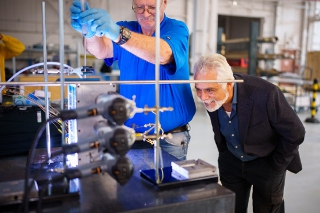
Sal Rodriguez, right, looks on as technologist Robin Sharpe injects dye into the dimpled model they built, showing the way dimples increase heat transfer in water. [Credit: Photo by Craig Fritz]
While his work is very practical, Rodriguez also hopes to have a little fun with it. He's already dreaming up new ideas. "Maybe we could do speedboats, jet skis, even frisbees," Rodriguez said.
Read more Sandia technical developments at sandia.gov/news/.
Source: Sandia
Published January 2024
Rate this article
View our terms of use and privacy policy