 |
| May 20, 2025 | Volume 21 Issue 19 |
Designfax weekly eMagazine

Archives
Partners
Manufacturing Center
Product Spotlight
Modern Applications News
Metalworking Ideas For
Today's Job Shops
Tooling and Production
Strategies for large
metalworking plants
World's most powerful commercial jet engine is getting ready for takeoff

The GE9X has undergone the equivalent of nearly two years of 24/7 testing. [Image courtesy of GE Aerospace]
By Chris Noon, GE Aerospace
According to GE Aerospace, the world's most powerful commercial jet engine is getting ready for takeoff. The GE9X high-bypass turbofan engine is expected to enter service next year on the wings of Boeing's 777X family, the world's largest twin-engine passenger jet.
The GE9X engine is a marvel of modern engineering. The fan diameter of the engine is a whopping 134 in. (3.4 m), a full foot taller than a regulation NBA basketball rim. While certified for 105,000 lb of thrust, it is capable of generating a record-breaking 134,000 lb of thrust, whipping up a miniature Category 5 hurricane in its wake. To date, the superlative engine has mainly forged its reputation with thousands of hours of both ground and on-wing testing. It also boasts 4th-generation composite fan blades in a 16-count design.
Now the engine is set to fulfill its purpose as the pride of the skies. GE9X engines are currently rolling off the production line and being loaded onto trucks for an epic cross-country haul, first to Ohio for rigorous testing and then onward to Boeing's factory in the Pacific Northwest.
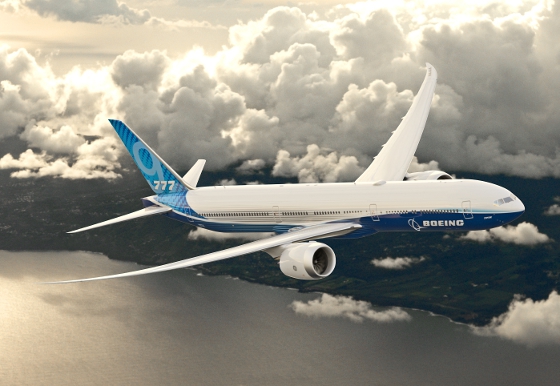
With new breakthroughs in aerodynamics and engines, Boeing says its 777X plane will deliver 10% lower fuel use and emissions and 10% lower operating costs than the competition. The 252-ft 777-9 version will have 426 seats and a range of 7,285 nmi. [Image courtesy of Boeing]
Cristina Seda-Hoelle, who heads up GE Aerospace's GE9X program, explains how plant activity in Durham will mirror that of Everett, Washington, where final assembly of the twin-engine 777X is underway in the world's largest factory. "We've started building," she says, "and we'll be aligning production with Boeing's production of the 777X."
King of the desert
A grueling boot camp awaits each assembled GE9X in Peebles, Ohio. The engine has undergone the most rigorous testing program of any GE Aerospace commercial engine to date. Seda-Hoelle says that the GE9X has now passed through 27,000 cycles and 17,000 hours of testing. That includes a total of 1,600 cycles of dust ingestion tests to ensure the engine's durability and performance in the more arid regions of the world where the Boeing 777X may operate.
"We've run the heck out of the engine, and customers have been really impressed by the dust test data coming back, which is the equivalent of almost three years of normal use on the engine," says Tyler-Blair Sheppard, who heads up marketing for the GE9X. After 1,500 cycles, borescope inspections showed that the engine -- especially the hot section, the high-temperature segment housing the combustion, turbine, and exhaust components -- looked great and was in serviceable condition, which allowed for an extra 100 test cycles. "It will all result in a more durable engine in harsh environments," adds Sheppard.
Of course, the quest to maintain durability standards won't stop there. GE Aerospace has completed thousands more cycles of ground testing to obtain Extended Operations (ETOPS) approval for the engine later this year. "Around June or July, we're going to lay out our disassembled ETOPS engine and data for our customers to see," says Sheppard. Engineers have also taken full advantage of an extended testing period to validate the sustainability gains from the GE9X engine, such as NOx emissions that are 55% lower than regulatory limits and nearly half those of any competing engine in its class.
A ready support network
GE Aerospace is also beefing up its maintenance, repair, and overhaul (MRO) capabilities to support its GE9X customers. Over the next four years, it will invest over $1 billion to increase capacity, enhance training, and add advanced tooling in its MRO shops worldwide. Whether GE9X customers are in Europe, Asia, the United States, or the Middle East, they will receive the full suite of services extended to all of GE Aerospace's popular engines, including overhaul, component repair, and advanced diagnostics.
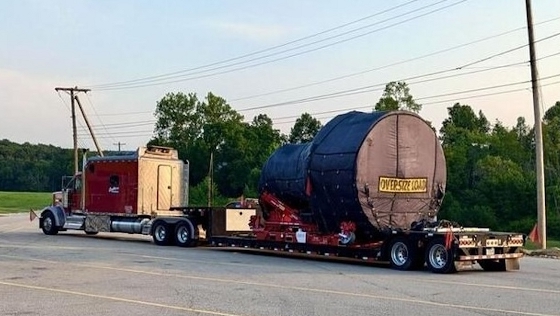
The first production GE9X engine leaving GE Aerospace's Peebles, Ohio, test facility in July 2024, on its way to Boeing's factory in Everett, Washington. [Image courtesy of GE Aerospace]
The production ramp-up will also manufacture engines for GE Aerospace's comprehensive lease pool program, which is designed to provide airlines and operators with flexible and immediate access to spare engines. "When issues occur, we'll be fully set up to support our customers and get them flying again as soon as possible," says Sheppard.
At this stage, the GE9X engine has undergone more hours of endurance and flight tests than any other GE Aerospace commercial aircraft engine before entry into service. After so many cycles of iteration and analysis, the team has made improvements that will help ensure reliability right out of the gate. When the GE9X enters into service on Boeing's 777X, it will mark a pivotal moment for the two companies -- a culmination of years of shared innovation, rigorous testing, and successful collaboration.
"The GE9X engine is an absolute beast of modern engineering," says Seda-Hoelle. "This isn't just cool -- it's a game changer that pushes the boundaries of technology. The GE9X is the epitome of power, precision, and innovation, making it the ultimate aviation showstopper."
Published May 2025
Rate this article
View our terms of use and privacy policy