 |
| May 27, 2025 | Volume 21 Issue 20 |
Designfax weekly eMagazine
Archives
Partners
Manufacturing Center
Product Spotlight
Modern Applications News
Metalworking Ideas For
Today's Job Shops
Tooling and Production
Strategies for large
metalworking plants
New rubber resists cracking, is 10x stronger
By Anne J. Manning, Harvard John A. Paulson School of Engineering and Applied Sciences
Natural rubber, one of the world's most widely manufactured biomaterials, has been used by humans for thousands of years. Its resistance to crack growth, however, hasn't improved much for decades.
Until now.
Materials researchers at the Harvard John A. Paulson School of Engineering and Applied Sciences (SEAS) have devised a way to produce natural rubber that retains its key properties of stretchiness and durability while greatly improving its ability to resist cracking, even after repeated cycles of use.
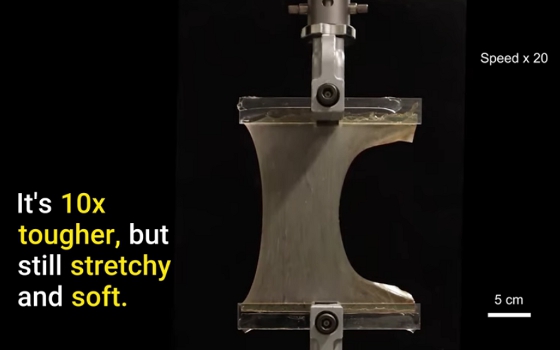
Harvard researchers have developed a new way to produce natural rubber that endows the material with higher crack resistance and durability. [Image courtesy of the researchers/Harvard John A. Paulson School of Engineering and Applied Sciences]
The work is published in Nature Sustainability and is led by Zhigang Suo, the Allen E. and Marilyn M. Puckett Professor of Mechanics and Materials at SEAS.
"Improving crack resistance will extend the material's service lifetime and therefore improve its sustainability," said first author and former SEAS postdoctoral researcher Guodong Nian.
Natural rubber is a durable polymer material that's in too many products to count: gloves, tires, shoes, medical devices, conveyor belts, and more.
Derived from natural rubber latex, a milk-like substance from the Hevea tree, rubber is harvested, coagulated, dried, mixed with additives, shaped, and heated to trigger vulcanization. This process creates short polymer chains within the material that are densely crosslinked, or chemically bonded.
The researchers modified this longstanding, high-intensity process to induce a gentler transformation that retains long polymer chains in their natural state, rather than cutting them into shorter chains. Resembling tangled spaghetti, their so-called rubber "tanglemer" endows the new product with heightened durability by outnumbering crosslinks with entanglements.
"We used a low-intensity processing method, based on latex processing methods, that preserved the long polymer chains," Nian said.
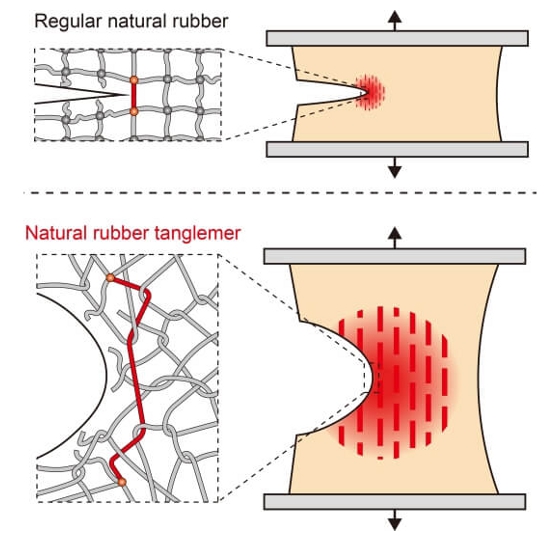
In the new rubber tanglemer, a long polymer strand at a crack tip de-concentrates stress over a long distance, making the material more resistant to crack growth than regular natural rubber. [Image courtesy of the researchers/Harvard John A. Paulson School of Engineering and Applied Sciences]
When a crack forms in the new material, the long spaghetti strands spread out the stress by sliding past each other, allowing more rubber to crystallize as it stretches, and overall making the material stronger and more resistant to cracking.
Their results blew away their expectations, said paper co-first author Zheqi Chen, a former SEAS postdoctoral researcher. The rubber became four times better at resisting slow crack growth during repeated stretching. It became 10 times tougher overall.
In their paper, the researchers state: "The long polymer strands amplify fatigue threshold to ~200 J m-2 and the synergy of the long polymer strands and the SIC amplifies toughness to over 105 J m-2."
In the current, "commonly adopted processes," the researchers noted "a fatigue threshold of ~40 J m-2" and "a toughness of ~104 J m-2" for traditional rubber.
"We imagined that the properties would be enhanced maybe twice or three times, but actually they were enhanced by one order of magnitude," Chen said.
The work highlights the benefit of preserving the natural state of long polymer chains. However, issues remain: The new material processing involves a large amount of water evaporation, yielding a smaller volume of material than would be desirable for products like tires. It is currently more suited to thin rubber products like gloves or condoms. Other possibilities the new process opens up are flexible electronics or soft robotics parts.
Published May 2025
Rate this article
View our terms of use and privacy policy