 |
| May 27, 2025 | Volume 21 Issue 20 |
Designfax weekly eMagazine

Archives
Partners
Manufacturing Center
Product Spotlight
Modern Applications News
Metalworking Ideas For
Today's Job Shops
Tooling and Production
Strategies for large
metalworking plants
Weird science: Rare crystal shape increases strength of 3D-printed aluminum alloy
Andrew Iams saw something strange while looking through his electron microscope. He was examining a sliver of a new aluminum alloy at the atomic scale, searching for the key to its strength, when he noticed that the atoms were arranged in an extremely unusual pattern. "That's when I started to get excited," said Iams, a materials research engineer, "because I thought I might be looking at a quasicrystal."
Not only did he find quasicrystals in this aluminum alloy, but he and his colleagues at the National Institute of Standards and Technology (NIST) found that these quasicrystals also make it stronger. They published their findings in the Journal of Alloys and Compounds.
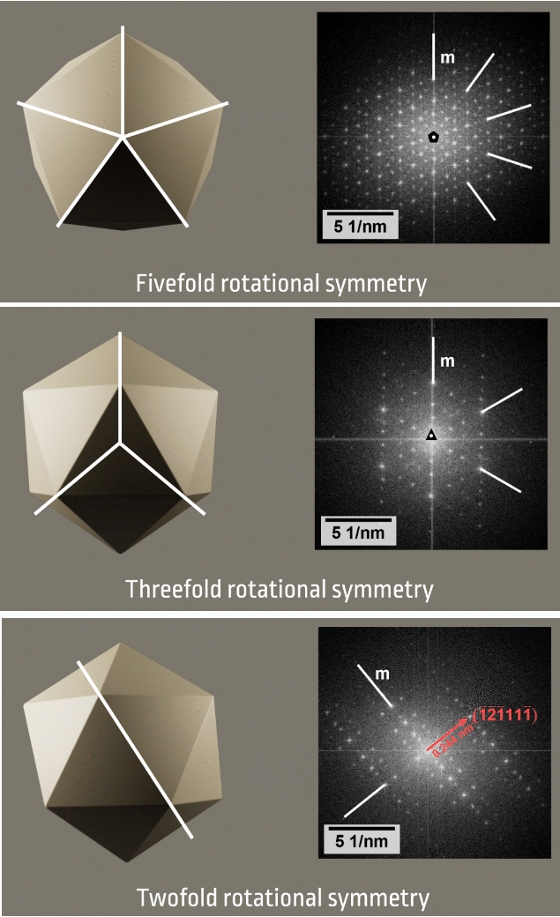
The quasicrystals found in this aluminum alloy study form the corners of a 20-sided shape called an icosahedron. To prove that he found an icosahedron, Andrew Iams had to rotate the sample under his microscope to show that it had fivefold, threefold, and twofold rotational symmetry -- all in the same crystal. [Credit: J. Wang/NIST]
The alloy formed under the extreme conditions of metal 3D printing, a new way to make metal parts. Understanding this aluminum on the atomic scale will enable a whole new category of 3D-printed parts such as airplane components, heat exchangers, and car chassis. It will also open the door to research on new aluminum alloys that use quasicrystals for strength.
What are quasicrystals?
Quasicrystals are like ordinary crystals but with a few key differences.
A traditional crystal is any solid made of atoms or molecules in repeating patterns. Table salt is a common crystal, for example. Salt's atoms connect to make cubes, and those microscopic cubes connect to form bigger cubes that are large enough to see with the naked eye.
There are only 230 possible ways for atoms to form repeating crystal patterns. Quasicrystals don't fit into any of them. Their unique shape lets them form a pattern that fills the space, but never repeats.
Dan Shechtman, a materials scientist at Technion-Israel Institute of Technology, discovered quasicrystals while on sabbatical at NIST in the 1980s. Many scientists at the time thought his research was flawed because the new crystal shapes he found weren't possible under the normal rules for crystals. But through careful research, Shechtman proved beyond a doubt that this new type of crystal existed, revolutionizing the science of crystallography and winning the chemistry Nobel Prize in 2011.
Working in the same building as Shechtman decades later, Andrew Iams found his own quasicrystals in 3D-printed aluminum.
One of the limitations of metal 3D printing is that it only works with a handful of metals. "High-strength aluminum alloys are almost impossible to print," said NIST physicist Fan Zhang, a co-author on the paper. "They tend to develop cracks, which make them unusable."
Normal aluminum melts at temperatures of around 700 degrees C. The lasers in a 3D printer must raise the temperature much, much higher: past the metal's boiling point, 2,470 degrees C. This changes a lot of the properties of the metal, particularly since aluminum heats up and cools down faster than other metals.
In 2017, a team at HRL Laboratories, based in California, and UC Santa Barbara discovered a high-strength aluminum alloy that could be 3D printed. They found that adding zirconium to the aluminum powder prevented the 3D-printed parts from cracking, resulting in a strong alloy.
The NIST researchers set out to understand this new, commercially available 3D-printed aluminum-zirconium alloy on the atomic scale. "In order to trust this new metal enough to use in critical components such as military aircraft parts, we need a deep understanding of how the atoms fit together," said Zhang.
The NIST team wanted to know what made this metal so strong. Part of the answer, it turned out, was quasicrystals.
How do quasicrystals make aluminum stronger?
In metals, perfect crystals are weak. The regular patterns of perfect crystals make it easier for the atoms to slip past each other. When that happens, the metal bends, stretches, or breaks. Quasicrystals break up the regular pattern of the aluminum crystals, causing defects that make the metal stronger.
When Iams looked at the crystals from just the right angle, he saw that they had fivefold rotational symmetry. That means there are five ways to rotate the crystal around an axis so that it looks the same.
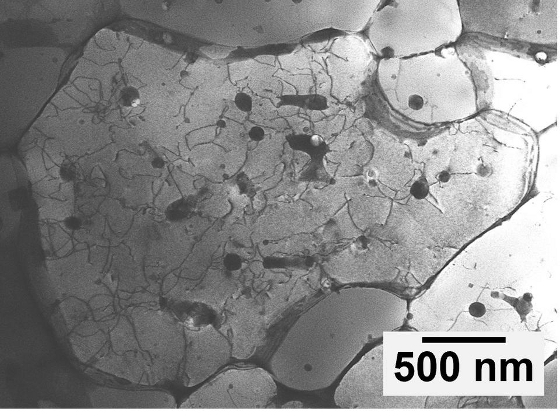
Electron microscope image of the aluminum alloy from the study. The light gray areas are sections of traditional crystals within the aluminum alloy, while the black dots are sections where NIST found quasicrystals. Meandering black lines emanate from the quasicrystal sections. These lines are defects that break up the pattern of traditional crystals throughout the alloy, increasing its strength. [Credit: Image courtesy of NIST]
"Fivefold symmetry is very rare. That was the telltale sign that we might have a quasicrystal," said Iams. "But we couldn't completely convince ourselves until we got the measurements right." To confirm they had a quasicrystal, Iams had to carefully rotate the crystal under the microscope and show that it also had threefold symmetry and twofold symmetry from two different angles.
"Now that we have this finding, I think it will open up a new approach to alloy design," said Zhang. "We've shown that quasicrystals can make aluminum stronger. Now people might try to create them intentionally in future alloys."
Source: National Institute of Standards and Technology
Published May 2025
Rate this article
View our terms of use and privacy policy