 |
| September 16, 2025 | Volume 21 Issue 35 |
Designfax weekly eMagazine
Archives
Partners
Manufacturing Center
Product Spotlight
Modern Applications News
Metalworking Ideas For
Today's Job Shops
Tooling and Production
Strategies for large
metalworking plants
Ferrari Testarossa: The 1980s icon is back!
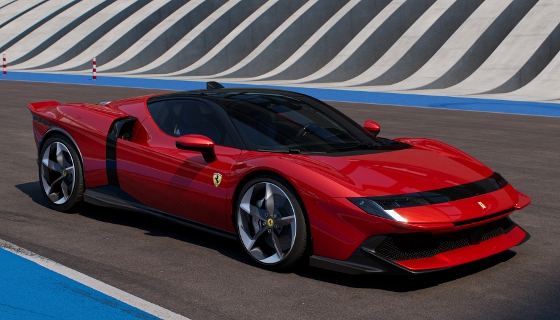
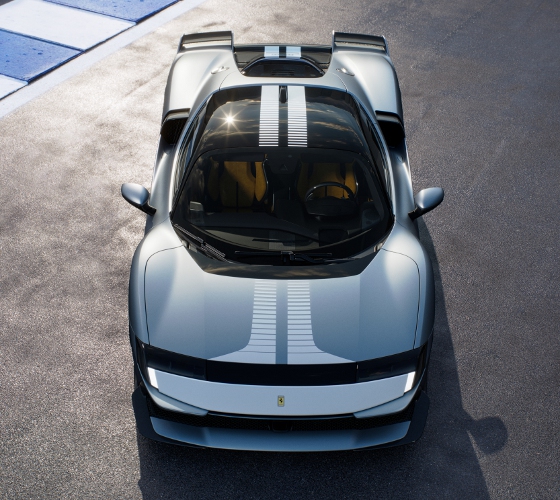
Ferrari 849 Testarossa. [Credit: All images courtesy of Ferrari]
The ultimate '80s supercar is back. Ferrari's latest sports car, the 849 Testarossa, is a hybrid plug-in super sports berlinetta equipped with three electric motors alongside the mid-rear twin-turbo V8, delivering a total of 1,035 hp -- 50 more than the car it replaces and an absolute record for a production Ferrari. It looks sweet too.
The 849 Testarossa takes its place at the top of Ferrari's range thanks to its performance, its ability to thrill the driver without ever compromising ride comfort or interior refinement, as well as its futuristic yet deeply historically rooted design. This car is conceived for the most demanding clients; those who want the very best from a Ferrari. It will be available in coupe and Spider (convertible) versions, and a special high-end trim level will be an option so discerning customers can pile on the non-standard equipment and really crank up that end cost.
The heart of the 849 Testarossa revolves around its twin-turbo eight-cylinder internal combustion engine, part of the family of engines that received multiple International Engine of the Year awards. The unit has been completely re-engineered to reach new performance peaks (an impressive 818 hp of max power) and is combined with an advanced hybrid system derived from Ferrari's motorsport experience. The hybrid system, consisting of a rear electric motor and two units installed on the front axle, is capable of delivering 217 hp. The on-demand four-wheel drive system and torque vectoring maximize performance in all conditions. The car sports an 8-speed dual-clutch automatic transmission. Ferrari says it will do 0 to 62 in 2.3 sec and has a top speed of 205 mph.
The regeneration strategy under braking has been revised to improve pedal feel even more, making pedal travel even smoother and more effective. The regenerative intervention is more progressive and natural, further improving the consistency between electrical and hydraulic deceleration. The battery and electric motor management strategies are calibrated according to the four electric driving modes: eDrive, Hybrid, Performance, and Qualify.
The 849 Testarossa's internal combustion engine (project code F154FC) is made of completely revised components, including the all-new turbocharger, cylinder heads, engine block, exhaust manifolds, intake plenums, titanium fasteners, valve train system, and fuel rail. A new, larger turbocharger has been adopted with F80-derived low-friction bearings and an innovative heat shield on the turbine casing inspired by the 296 GT3 to improve thermal management in the engine compartment. The intercooler has been optimized in order to manage the increase in power and improve thermal efficiency.
The increase in engine power was achieved without any significant weight penalty thanks to machining inspired by racing engines, lightening of the camshafts, and the adoption of titanium screws, improving the weight/power ratio by almost 10% compared to the SF90 Stradale. The Inconel exhaust manifold sees the diameter of the ducts increase by 20% and its length by 10% to improve the performance and provide the timbre typical of the Ferrari sound.
The exhaust system integrates GPFs (Gasoline Particulate FilterS) and a new generation ceramic matrix for the catalyzers, which keep the layout unchanged while complying with regulatory requirements without any significant increase in mass. The 849 Testarossa, for the first time on a Prancing Horse range car, has also introduced the use of recycled aluminum secondary alloys for engine castings (cylinder head, crankcase, and sump).
To enhance its dynamic qualities and the driver feedback at the limit, the 849 Testarossa is equipped (in addition to the latest generation brake-by-wire system) with Ferrari's ABS Evo controller, which improves braking precision and consistency in all conditions, along with the new braking system. The spring and damper setup has been completely revised for improved behavior at the limit of grip. Extensive component weight reduction has allowed the 849 Testarossa to boast the best power-to-weight ratio ever for a range model, since the impressive performance increase has not resulted in any additional weight compared to the SF90 Stradale.
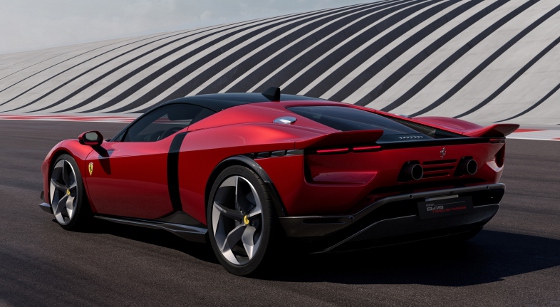
The 849 Testarossa sounds sweeter too. The sound level has been increased at all speeds, with particular attention to the richness and purity of the sound in the low and mid ranges. The new gear shift strategy, inherited from the SF90 XX Stradale, has been revised to generate an even more exciting sound during upshifts in press-on driving. This effect has been achieved through a new engine calibration that works in synergy with the gearbox control logic, optimizing the sequence of actuations and the pressure in the combustion chamber to maximize sound intensity during liftoff.
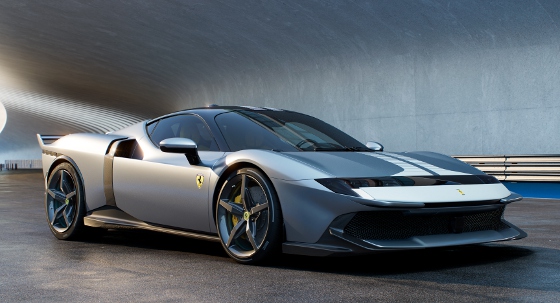
From a styling point of view, the 849 Testarossa marks a revolution in the concept of a Ferrari V8 mid-rear berlinetta. The inspiration taken from 1970s Sports Prototypes, together with sharp and geometric lines, creates a unique and timeless design. The synergy between form and function has enabled impressive aerodynamic performance: The total downforce of 415 kg at 250 km/h represents a 25-kg increase over the SF90 Stradale as well as providing a 15% boost in cooling power for the powertrain and brakes.
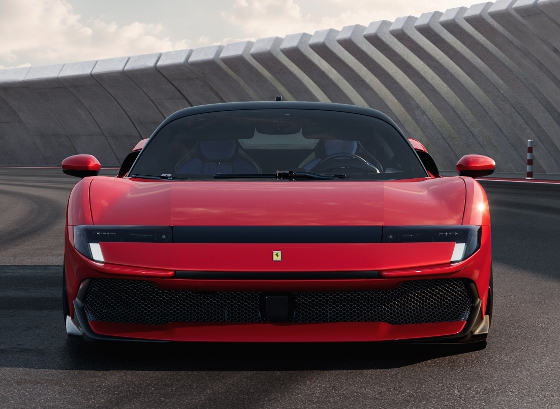
The front has structured volumes that recall Ferrari geometries from the 1980s. A bridge-like horizontal fascia connects the headlights, recalling the styling theme already used on the Ferrari 12Cilindri and F80. This element creates a new ratio between volumes and voids in the surface treatment, which creates a full-width spoiler effect. The body-colored flicks and the black splitter complete the lower area of the bumper, reinforcing the technical and aerodynamic characteristics.
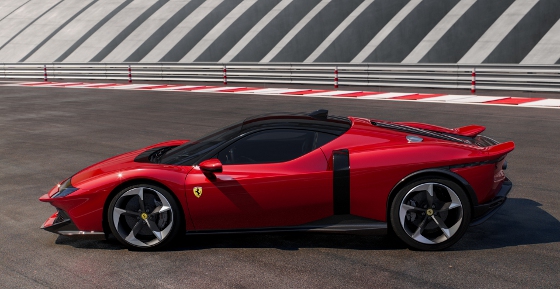
The volume of the bodywork flanks has been optimized to increase the amount of air flowing to the intercoolers by 30%. A channel has been scooped out in the door to feed the lower portion of the intercooler, while the lower surface of the duct is equipped with a blow that allows the boundary layer to be captured. The side air intake trim wraps around the bodywork up to the sill cover and has a profiled shape with an upper auxiliary inlet to maximize the air flow to the radiating masses. The side inlet, in addition to the intercooler, also feeds the rear brake duct and the engine intake.
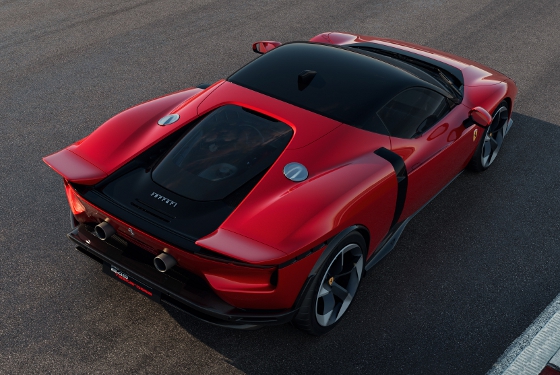
The front underfloor, responsible for 35% of the total downforce, has been completely redesigned: Three pairs of cascading vortex generators maximize outwash and intake, guaranteeing a 20% increase in downforce compared to the SF90 Stradale. The squarer front bumper has integrated bumperettes that help increase the airflow to the front air intakes and generate vorticity useful for extracting the flow from the wheel arch. The splitter (also larger in size) incorporates a flick, inspired by the SF90 XX Stradale, responsible for 10% of the front downforce.
The flank is dominated by the door with a three-dimensional modeling that starts from the main crease line. The deeply sculpted upper surface of the door has a complex three-dimensionality that Ferrari says has never been achieved before on a standard production car and redefines the relationship between the car body and the cabin area. The panel is made of a single aluminum alloy molding thanks to Ferrari's advanced manufacturing processes.
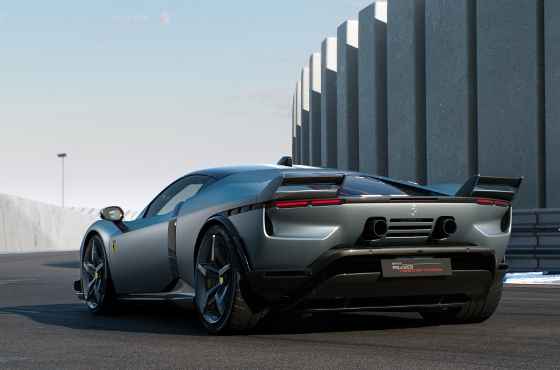
This car looks particularly impressive from the back. The rear adopts a twin-tail architecture inspired by the 512 S, with two wing sections (called twin tail) that exploit the high-energy flow that laps the top of the muscular rear wheel arches to generate 10% of the downforce at the rear. The active rear spoiler, derived from that of the SF90 Stradale and the 296 GTB, is integrated into the bodywork and actioned by a kinematic solution that is 2 kg lighter. It is capable of switching between Low Drag and High Downforce configurations in less than a second. In High Downforce configuration, it helps to generate up to 100 kg of downforce at 250 km/h, working in synergy with the passive elements of the tail.
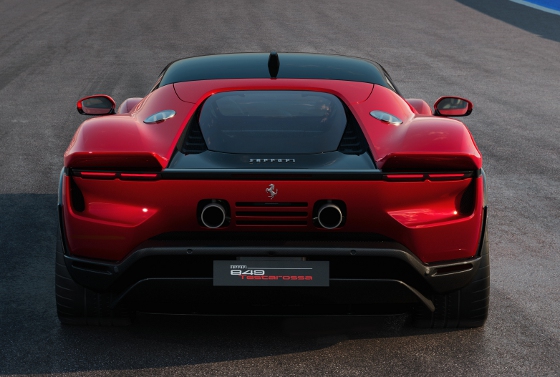
The rear underbody adopts a multi-level diffuser with a suspended lower element and vertical fences that allow the wheel wake to be isolated. A pair of vortex generators with an oversized chord maximizes expansion at the height of the rear axle. The downforce generated by the rear underfloor is aligned with that of the SF90 Stradale, with a 10% reduction in drag.
When developing the handling of the 849 Testarossa, Ferrari's engineers set out to define driver feedback using five indicators: lateral and longitudinal acceleration, gear change, braking, and sound. Lateral acceleration was optimized by working on the suspension geometry and management of the electronic vehicle dynamics controls to provide a faster response to steering wheel inputs and improving the mechanical grip of the rear axle. Longitudinal acceleration benefits from a quicker response to the accelerator pedal and the increase in maximum power available. The gearshift strategy has been refined to provide a more progressive feel and reduce actuation times. Braking efficiency has been improved, as has pedal feel and travel, thanks to the introduction of the ABS Evo developed for the SF90 XX Stradale. The sound has been calibrated to accurately replicate accelerator response in terms of quality through the rev range.
The car's new FIVE system represents a significant evolution in dynamic controls. It is an estimation system capable of creating a digital twin that replicates the behavior of the car in real time, based on a simplified mathematical model powered by real measurements (acceleration, 6D sensor). FIVE accurately estimates performance characteristics that cannot be directly measured -- such as speed (with a margin of error of less than 1 km/h) and yaw angle (margin of less than 1 degree) of the vehicle -- improving traction control, electronic differential management, and e4WD system delivery. These estimates feed into all vehicle dynamics controls, making the response more precise and repeatable.
The braking system has also been completely revised to handle the higher level of performance. There are larger discs and pads all round, while the front discs feature optimized ventilation channels and the new rear callipers have been optimized to improve thermal management and rigidity. The synergy between these components guarantees thermal efficiency, structural strength, and consistency of performance even under prolonged use.
The 849 Testarossa features a dedicated suspension setup and kinematic angles, optimized for handling on the limit. The increase in lateral performance compared to the SF90 Stradale is 3%, thanks to the new tires and specific setup, which also brought a 35% reduction in the weight of the road springs. The roll gradient has been reduced by 10%, improving the management of body motion and maximizing aerodynamic benefits and dynamic camber. The shock absorber damping has been optimized through virtual and physical sessions, replicating both road and track driving.
The increase in longitudinal acceleration achieved in third gear compared to the SF90 Stradale, which is noticeable from 5,500 rpm onwards, is the combined result of the improved weight-to-power ratio, the increase in performance of the combustion engine at high revs, and the dedicated shaping of the overall power delivery. This improvement was achieved without compromising low-end response.
Despite the introduction of components to match the increased performance which would have increased the weight by more than 20 kg, the 849 Testarossa is the same weight as the SF90 Stradale thanks to extensive work on the lightening of the masses. The result is the best power-to-weight ratio ever achieved by a model in the range.
The forged wheels have been developed in close synergy with the aerodynamics department. Prominent aerodynamic profiles with extended diamond-cut treatment optimize air extraction from the wheel well and control wake. The geometries allow for extensive aesthetic and functional customization.
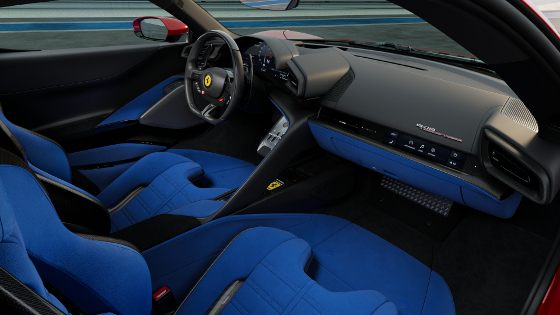
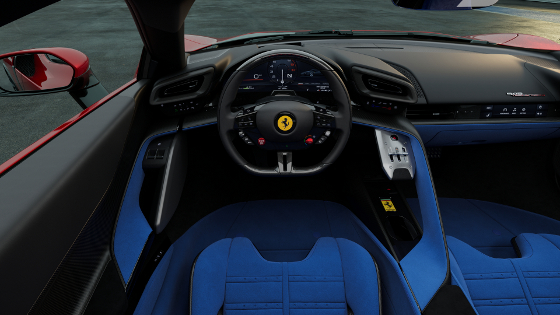
The cockpit is even more enveloping and ergonomic than before. The central sail motif with the integrated gear-change gate, inspired by the F80, improves the positioning of components and makes them more accessible. The new steering wheel, equipped with mechanical buttons (including the iconic engine start button), elevates the driving experience while maintaining the high functionality of the latest-generation Ferrari steering wheels. Finally, a new HMI system makes interaction with the car even simpler and more intuitive.
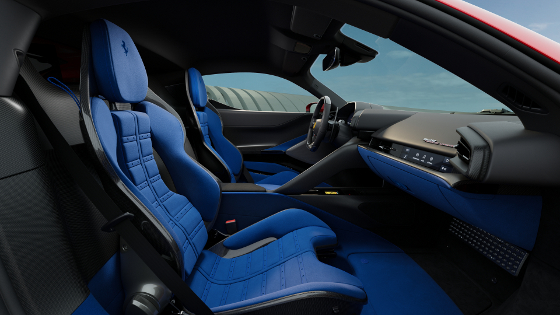
The interior design sets out to optimize space and improve ergonomics. Accessibility has been improved by reducing the width of the bottom of the door panel and adjacent areas, thus freeing up additional space for the rear bench and the passenger-side glove box.
The seats are available in two versions: comfort, with a sculptural treatment of the upholstery and styling that matches the geometry of the cockpit, and a carbon-fiber racing seat, with sporty side bolsters for ideal lateral containment. Both versions are the result of a combined study of ergonomics and style.
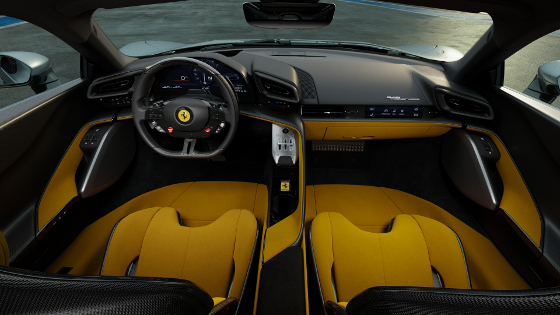
The user interface is designed to concentrate functions around the driver, with an enveloping effect that also involves the door panel and the central tunnel. The passenger area formally takes up this effect, less explicitly. The car is also equipped with the MyFerrari Connect system, which allows the vehicle to be monitored remotely via a dedicated App.
If you want to take it all up a notch, the Assetto Fiorano trim level is an optional configuration of the 849 Testarossa with exclusive content that is not available on the standard car. It has been developed to maximize the car's dynamic and aerodynamic performance. The Assetto Fiorano specification provides for an overall weight reduction of about 30 kg, obtained thanks to the extensive use of composite materials such as carbon fiber and titanium. Specific components include the new lightweight tubular seat upholstered in black Alcantara, which saves around 18 kg compared to the standard seats, and 20-in. carbon fiber wheels that reduce unsprung mass and improve responsiveness when accelerating and braking.
From an aerodynamic point of view, the Assetto Fiorano specification also introduces substantial changes. The front is characterized by larger flicks and the front underfloor is equipped with an additional pair of vortex generators, which increase the local aspiration, ensuring perfect aerodynamic balance. At the rear, two twin wings replace the twin tails -- these are spoilers surmounted by high-incidence aerodynamic profiles, set between two vertical endplates. This solution makes it possible to triple the vertical downforce compared to that of the twin tails without significantly penalizing aerodynamic drag.
Customers can also specify stiffer, single-rate Multimatic shock absorbers, springs lightened by 35%, and a roll gradient reduced by 10%, improving body control and aerodynamic efficiency. For the first time, it is also possible to equip the Assetto Fiorano specification with the front lifter as part of the semi-active Magneride suspension system -- owners will need it with such a low-front car! Among the tires available are the Michelin Pilot Sport Cup2 tires, specific for this version. Lots more options.
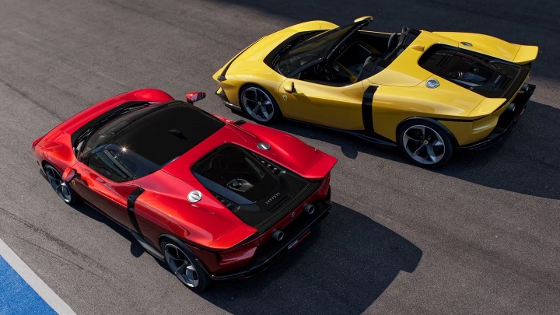
This car will be model year 2027 and available mid 2026. Prices: 460,000 euros ($540,000) for the coupe and 500,000 euros ($586,000) for the Spider version. Assetto Fiorano trim level builds on these numbers -- sky's the limit.
Source: Ferrari
Published September 2025
Rate this article
View our terms of use and privacy policy