 |
| September 23, 2025 | Volume 21 Issue 36 |
Designfax weekly eMagazine
Archives
Partners
Manufacturing Center
Product Spotlight
Modern Applications News
Metalworking Ideas For
Today's Job Shops
Tooling and Production
Strategies for large
metalworking plants
Weird science: New updates on how to handle cardiac arrest in space
New research has found a more effective way to conduct cardiopulmonary resuscitation (CPR) in microgravity. The study found that a type of automatic chest compression, carried out by a standard mechanical piston device, reached the depth needed to be effective, while the current CPR methods recommended for space travel are undereffective regarding this depth criteria.
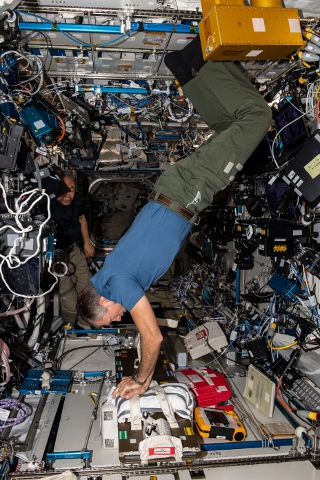
Expedition 70 Commander Andreas Mogensen of the European Space Agency stabilizes himself in the microgravity environment of space so he can practice CPR using the handstand method inside the ISS's Destiny lab module in October 2023. Emergency training sessions like this are regularly scheduled on the ISS. [Credit: Image courtesy of NASA]
Treating cardiac arrest during spaceflight is challenging, because both the rescuer and the patient are floating due to microgravity. The current NASA emergency protocol for the International Space Station (ISS) recommends the handstand method of CPR, where the rescuer performs a handstand on the patient's chest, with their legs pressing on the side of the spaceship to create the pressure needed for chest compressions.
"We tested different ways of giving chest compressions aboard a 'flying laboratory' that recreated the microgravity conditions that astronauts experience in space," said Nathan Reynette from the Cardiology Department at Universite de Lorraine - CHRU de Nancy in France. "Use of a particular type of automatic chest compression device was the only method that gave the depth that is recommended by international resuscitation guidelines to keep blood flowing to the brain in a real-life cardiac arrest. We hope that our findings will be incorporated into the next guidelines for treating cardiac arrest in space."
The research was conducted in a flying laboratory onboard a modified civil aircraft, the only one of its kind in Europe, called the A310 Air Zero G at the Centre National d'Etudes Spatiales, the French space agency. Freefalling phases of parabolic flight were used to accurately recreate microgravity for 22 seconds during each parabola, with around 30 parabolas per single fight. The experiments were conducted over three flights. Chest compression depths and rates were monitored by a high-fidelity CPR training manikin.
Earth-based chest compressions during CPR count in part on the rescuer's weight for effectiveness, which cannot be used to such effect in microgravity. As a result, over the last 30 years, researchers have searched for alternative methods, such as the handstand method, reverse bear hug method, and the Evetts Russomano method. Until now, despite numerous trials, none of the proposed methods have been shown to reach the depth standards needed for effective chest compressions.
Three types of automatic chest compression devices were tested. Automatic chest compression devices are routinely used on Earth by doctors in restricted environments such as in an emergency helicopter, or where prolonged CPR needs to be carried out over a longer period of time, such as refractory cardiac arrest, which can last for more than 40 minutes. This type of CPR is not considered to be superior to manual CPR in normal conditions, but it has been proven to be effective when chest compressions are challenging.
Three types of automatic chest compression devices were tested: a standard mechanical piston device, a compression band device, and a small-sized piston device. Best practice guidance, such as advice given by the European Resuscitation Council, suggests that, to be effective, chest compressions must reach a depth of between 50 to 60 mm.
Of the three automatic chest compression devices tested, the standard mechanical piston device had the highest median compression depth. The median compression depth of the standard mechanical piston device was 53 mm, which was considerably more than the other two automatic chest compression devices that both had median depths of 29 mm, and the manual handstand method of CPR, which achieved a depth of 34.5 mm.
Reflecting on whether future space missions will take automatic chest compression devices in their emergency medical kit, Reynette said, "It will be up to every space agency whether they want to include automatic chest compression devices in their emergency medical kit. We know they have other considerations beyond effectiveness, such as weight and space constraints.
"While cardiac arrest is a high-danger event that could even terminate a space mission, it is a relatively low risk for now," said Reynette. "Most astronauts are young, healthy, and physically fit individuals who have intensive medical monitoring, including scanning for chronic heart disease, before going into space. Nevertheless, longer lasting space missions in the future and space tourism could increase the risks of a medical emergency occurring."
"This research highlights once again the usefulness of automated chest compression devices to perform CPR in challenging environments. Space medicine often provides transferable lessons for emergency procedures in isolated environments on Earth, where space and clinical experience are also limited. Further research could explore whether automated chest compression devices could prove useful to carry out CPR in environments such as submarines and artic bases," Reynette added.
Source: European Society of Cardiology
Published September 2025
Rate this article
View our terms of use and privacy policy