 |
| March 18, 2014 | Volume 10 Issue 11 |
Electrical/Electronic News & Products
Designfax weekly eMagazine

Archives
Partners
Manufacturing Center
Product Spotlight
Modern Applications News
Metalworking Ideas For
Today's Job Shops
Tooling and Production
Strategies for large
metalworking plants
High-capacity benchtop video measurement system
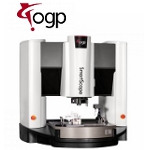 Optical Gaging Products has introduced the SmartScope® E18, a compact, benchtop video measurement system. Featuring a 12" x 12" stage, IntelliCentric™-E fixed-lens optics, and VIRTUAL ZOOM™ technology, it offers fully automatic 3-axis performance without taking up floor space. Standard LED lighting, a rigid fixed-bridge design, optional touch probes, and advanced metrology software ensure accurate, repeatable inspection.
Learn more.
Tech Tip: Fan selection - Why airflow is not just CFM
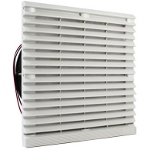 For many engineers, fan selection starts and ends with a single number: CFM (cubic feet per minute). Higher CFM feels like a clear win. More air moved must mean better cooling. However, in practice, this assumption is one of the most common causes of thermal problems, excess noise, and late-stage redesigns. Find out why.
Read this Orion Fans technical article.
Useful! Snap-together LED enclosure lighting
 Seifert StripLite SL 4000 Series LED enclosure lighting provides bright illumination to 700 lumens. On/off switch and motion sensor models are available. Easily daisy chain up to 16 light strips. Magnetic or clip mounting. See video/info on website or contact Bristol Instruments for more information.
Learn about snap-together lighting.
The hidden hardware helping AI's heat problem: PCHEs
 Across AI infrastructure, thermal constraints now connect semiconductor design with power and cooling systems. More compact, lighter, and efficient than conventional shell-and-tube models, printed circuit heat exchangers save floor space, reduce energy costs, and improve overall efficiency in dense, hyperscale environments.
Read the full article.
Nearly 1,000 parts: Industrial enclosure range expanded
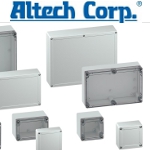 Altech Corp. has expanded its industrial enclosure lineup to 10 unique series with nearly 1,000 parts! Designed for control, junction, and terminal applications, these plastic and aluminum housings offer up to IP69 protection. They mount directly to walls or panels, resisting chemicals, corrosion, flames, impacts, and severe outdoor conditions without sacrificing aesthetics.
Find your perfect enclosure today.
Cool Tools: MetraSCAN BLACK2 -- Next-gen shop-floor 3D inspection
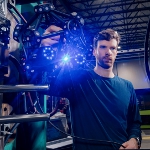 You'll gain some superhero powers when you brandish FARO CREAFORM's new MetraSCAN BLACK2, a next-gen portable metrology-grade optical 3D scanner engineered to deliver total inspection flexibility on the shop floor. This unit boasts a 3-in-1 architecture that combines C-Track scanning, stand-alone scanning, and probing in a single metrology-grade system.
Read the full article.
Compact, touchless position sensors: Wear-free operation in tight spaces
Novotechnik's TFD-4000 Series of touchless linear position sensors delivers wear-free measurement in tight spaces. Featuring ranges up to 50 mm, IP67 protection, 12-bit resolution, and analog outputs, these reliable sensors operate from -40 C to 125 C across diverse industrial, mobile, and medical applications such as short-stroke linear valve positioning, solenoid valves, off-highway brake actuation, and more.
Learn more.
World's first 10-m safety laser scanner: See farther, protect more
Datasensing, Datalogic's Sensor & Safety and Machine Vision business unit, has launched the SLS10 Safety Laser Scanner, the world's first 10-meter safety laser scanner. Delivering a 275-degree scanning angle, 240-m2 of coverage, and an 84-msec response time, the SLS10 protects larger workspaces with fewer devices. It features best-in-class angular resolution for precise AGV navigation, SIL-2/PLd compliance, dust immunity, and the new ONEGUI platform for simplified configuration.
Learn more and see it in action.
Accelerate AI-driven machine vision systems
BitFlow has announced full production of its Claxon CXP-12 frame grabbers, designed for NVIDIA GPU-accelerated machine vision. Across five models, the CoaXPress 2.0 lineup delivers up to 50 Gbps -- five times 10 GigE Vision -- eliminating data bottlenecks. The full CXP-12 specification ensures deterministic, high-bandwidth streaming to unleash modern AI inference models.
Learn more.
Millimeter-wave imaging inspection in real time
With its new quality and inspection R&S IMAGER millimeter-wave scanner, Rohde & Schwarz aims to simplify the industrial inspection of packaged products. The system sees through common packaging materials at production speed without using X-rays, protecting both products and operators. The high-contrast 3D images are used as digital twins and can be automatically integrated into AI-powered fault-detection systems. Sees through plastics, cardboard, and composites. Applications include food and beverage, pharmaceuticals, logistics.
Learn more.
What are single-loop process controllers?
PLCs are powerful, but complex control isn't always necessary. For standalone processes requiring single-variable monitoring -- like temperature, pressure, or flow -- a single-loop controller is ideal. See how single-loop controllers can streamline your next project.
Read the AutomationDirect tech tip.
Great Resources: Flexible circuit design guide
Tech-Etch uses advanced techniques to manufacture flex and rigid-flex circuits to exacting customer specs. Special processes include selective plating a single circuit with two different finishes, contoured circuits with variable metal thickness, semi-additive and subtractive techniques, open window or cantilevered contact leads, plus SMT for component assembly. Tech-Etch specializes in flexible circuits for medical, telecommunications, aerospace, semiconductor, and other high-reliability electronic applications.
Learn about flex circuits and get the guide (no registration required).
EMI Investigations: New immunity development system
Saelig Company announces the Langer E1 Immunity Development System for EMI investigations. This compact, affordable kit simulates burst and ESD interference to pinpoint layout weak spots down to IC pins. By eliminating "black box" guesswork early in development, engineers can efficiently identify coupling mechanisms, test measures, and resolve immunity issues before compliance failure.
Learn more and see it in action.
Battery packs for unmanned aerial vehicles
Re:Build Manufacturing has launched U.S.-assembled, NDAA-compliant lithium-ion battery packs for commercial, public safety, and defense UAV applications. Available in Core, Power, and Performance series, the packs use non-FEOC cells and are produced at Re:Build's advanced facility in New Kensington, PA. Re:Build also offers custom pack and battery management system development.
Learn more.
Easy-to-use precision measurement system
Optical Gaging Products has announced the StarLite S1, a compact, semi-automatic 3-axis video measurement system. It combines fully automatic video measurements with manual stage motion and features an IntelliCentric-S optical system for high-resolution images. Powered by Measure-X software, this system delivers fast, repeatable, high-accuracy results, making it ideal for both shop-floor and quality-control applications.
Learn more.
Physicists celebrate the SQUID (superconducting quantum interference device) at 50
From humble beginnings in a series of accidental discoveries, SQUIDs have invaded and enhanced many areas of science and medicine, thanks, in part, to the National Institute of Standards and Technology (NIST).
SQUIDs -- short for superconducting quantum interference devices -- are the world's most sensitive magnetometers and powerful signal amplifiers, with broad applications ranging from medicine and mining to cosmology and materials analysis.
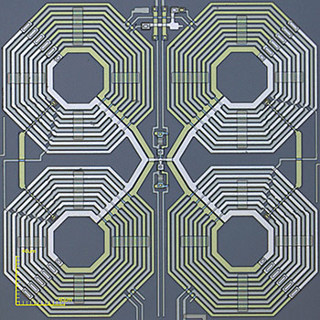
Micrograph of a SQUID amplifier, made at NIST in 2012, that is part of a circuit used to read signals from arrays of superconducting sensors. Small currents generated by the sensors are carried and amplified in the coils, which create magnetic fields detected by the SQUID (two small squares in the center of the image). [Credit: NIST]
Physicists from around the world celebrated the first week of March1 to mark the 50th anniversary of the first journal paper introducing the SQUID, published in February 1964.
Celebrants heard about the use of SQUIDS to measure brain activity in Finland, discover mineral deposits leading to a large silver mine in Australia, and detect faint light from the early moments of the universe from telescopes all over the world.
SQUIDs measure magnetic fields based on quantum properties created when a superconducting circuit loop, in which electricity flows without resistance, is interrupted with one or two short sections of resistive material. The current across the resistive section varies predictably, based on the strength of the external magnetic field, making the device an exquisitely sensitive detector of magnetic fields. Typically, SQUIDs need to be cooled to cryogenic temperatures below 4 kelvins (-269 deg C) with liquid helium.
The SQUID was invented at Ford Scientific Laboratories in the 1960s but was further developed at NIST (then called the National Bureau of Standards). James Zimmerman co-invented one type of SQUID (the RF-SQUID) and coined the term while at Ford, before joining NIST where he worked in the 1970s and 1980s.
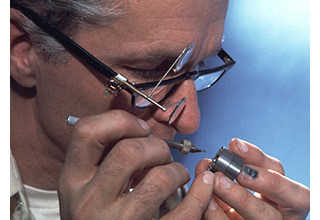
Jim Zimmerman with a multi-hole RF-SQUID, a design concept he developed at NIST in the 1970s. [Credit: NIST]
One of his SQUIDs helped launch the field of biomagnetism -- the medical use of SQUIDs. The first magnetocardiogram (MCG) with a strong, low-noise signal was performed with a portable SQUID made by Zimmerman at NIST to measure the magnetic signal of his own heart.2 The experiment, performed at the Massachusetts Institute of Technology, was the first time a SQUID recorded a living signal, and launched a growing field today.
Among other advances at NIST, Zimmerman also made early SQUIDs for magnetoencephalography (MEG), which noninvasively measures magnetic fields produced by electrical activity in the brain. In 1987, Zimmerman and NIST colleagues used a then-new high-temperature superconductor to make the first RF-SQUID -- and probably the first superconducting electronic device of any kind -- to operate at the temperature of liquid nitrogen, a relatively inexpensive and easily handled coolant.
Today, NIST remains a center of SQUID innovation. In addition to designing and making custom SQUIDs in a microfabrication facility, NIST researchers also invented a method for wiring hundreds of SQUID signal amplifiers together with large arrays of superconducting sensors. When used as amplifiers, SQUIDs measure the magnetic fields created in coils that carry and amplify very small currents generated by sensors.
For instance, SQUIDs made at NIST have been used to amplify sensor signals in more than 10 telescopes in North and South America, Hawaii, the South Pole, and elsewhere.3 NIST SQUIDs also are used in imaging of hidden threats4 and for X-ray materials analysis.
1The SQUID at 50: Impact and Future, Industrial Physics Forum at the American Physical Society March Meeting 2014, March 4, 2014, Denver, Colo.
2R.L. Kautz. Jim Zimmerman and the SQUID. IEEE Transactions on Applied Superconductivity, Vol. 11, No. 1, March 2001.
3For example, see the 2011 NIST Tech Beat article, "Powerful NIST Detectors on Hawaiian Telescope to Probe Origins of Stars, Planets and Galaxies," at www.nist.gov/pml/div686/scuba2-array.cfm and the 2013 NIST Tech Beat article, "NIST Goes to the End of the Earth for Measurement Science," at www.nist.gov/pml/div686/southpole-040313.cfm.
4See the 2013 NIST Tech Beat article, "NIST Unveils Prototype Video Imaging System for Remote Detection of Hidden Threats," at www.nist.gov/pml/div686/detection-093013.cfm.
Rate this article
View our terms of use and privacy policy