 |
| December 02, 2014 | Volume 10 Issue 45 |
Electrical/Electronic News & Products
Designfax weekly eMagazine

Archives
Partners
Manufacturing Center
Product Spotlight
Modern Applications News
Metalworking Ideas For
Today's Job Shops
Tooling and Production
Strategies for large
metalworking plants
Test equipment advancing to meet rapidly changing market needs
 Although the rise of the IoT, 5G, and advanced automotive electronics markets is instigating rapid changes in technology, test equipment is keeping pace, and not just in extensions to bandwidth specifications or signal resolution. Maureen Lipps, Multicomp Pro Private Label Product Segment Leader, Test and Tools, Newark Electronics, runs through important advances in the industry and its tools.
Read the full article.
Smallest rugged AI supercomputer for avionics
 Aitech Systems has released the A178-AV, the latest iteration of its smallest rugged GPGPU AI super-computers available with the powerful NVIDIA Jetson AGX Xavier System-on-Module. With its compact size, the A178-AV is the most advanced solution for artificial intelligence (AI), deep learning, and video and signal processing for next-gen avionic platforms.
Learn more.
Touchless angle sensors get CAN SAE J1939 interface
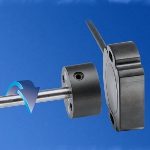 Novotechnik has added the CAN J1939 interface (developed for heavy-duty vehicles) to its RFC4800 Series of touchless angle sensors measuring angular position up to 360°, turn direction, turns, speed, and operational status. It can provide one or two output channels. It has a longer life and robustness than an optical encoder. It can signal if a sensor needs replacing or average a programmable number of values to output to reduce external noise if present. This is wear-free angle measurement made easy.
Learn more.
Radar level sensor monitors liquids and powders
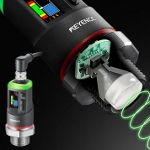 The innovative FR Series non-contact radar level sensor from Keyence has been designed to monitor the level of both liquid and powder in any environment. This sensor features short- and long-range models, as well as chemical and sanitary options to address a wide array of level sensing applications. Works even when obstructions or harsh conditions are present, such as build-up, steam, or turbulence.
Learn more.
Raspberry Pi launches $70 AI Kit
 Artificial intelligence (AI) is all the rage, and the makers of Raspberry Pi have created a way for enthusiasts of the single-board computer systems to take part and do a lot of experimenting along the way.
Read the full article.
3D model sharing at Brother Industries cuts rework
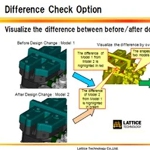 When Brother Industries, maker of printers, computers, and computer-related electronics, deployed Lattice Technology's XVL Player as a viewer for sharing 3D models throughout the processes of product design, parts design, mold design, mold production, and QA of molded parts, they reduced rework significantly -- especially from downstream departments. XVL Studio with its Difference Check Option helped address the rework in mold design, for example, by always keeping everyone informed of design changes.
Read this real-world case study.
What is 3D-MID? Molded parts with integrated electronics from HARTING
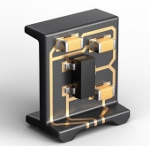 3D-MID (three-dimensional mechatronic integrated devices) technology combines electronic and mechanical functionalities into a single, 3D component. It replaces the traditional printed circuit board and opens up many new opportunities. It takes injection-molded parts and uses laser-direct structuring to etch areas of conductor structures, which are filled with a copper plating process to create very precise electronic circuits. HARTING, the technology's developer, says it's "Like a PCB, but 3D." Tons of possibilities.
Learn more (video included on page).
New! Thermoelectric dehumidifiers for enclosures
 Seifert Systems has just introduced its line of compact Soliflex® Series thermoelectric dehumidifiers, with or without condensate pump. These IP 56-rated units are designed to dehumidify enclosures and small control panels, can be used indoors or outdoors, and are maintenance free. When used with a hygrostat, Soliflex dehumidifiers will keep enclosure humidity below a defined level and only operate when needed.
Learn more.
More Stego enclosure heater options from AutomationDirect
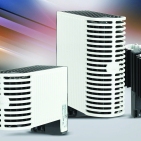 Automation-Direct has added more Stego enclosure heaters to their Enclosure Thermal Management lineup. These new 120 to 240 VAC/VDC units include small, flat versions that distribute heat evenly within compact enclosures and are available with 8- or 10-W heating capacities. Also added are compact loop heaters that feature a patented loop body design for increased natural convection airflow, reduced thermal stress on the heater, and better heat transfer. Loop heaters are available in 10- to 150-W heating capacities.
Learn more.
Great design: Handle with integrated lighting/signaling
 Signaling and indicator lights, switches, and buttons -- elements that hardly any machine can do without. The new JW Winco cabinet U-handle EN 6284 integrates all these functions into a single, compact element. The new U-handle is designed to enhance the operation of systems and machines. It features an integrated button and a large, colored, backlit area on the back of the handle. These elements can be used individually or in combination, providing a versatile tool for system control and process monitoring that can be seen from across the room.
Learn more.
Engineer's Toolbox: What is ground loop feedback?
 Improper grounding can create problems in data logging, data acquisition, and measurement and control systems. One of the most common problems is known as ground loop feedback. Experts at CAS DataLoggers run through five ways to eliminate this problem.
Read the full article.
AI development kit for multi-camera products
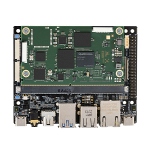 The QCS6490 Vision-AI Development Kit from Avnet enables engineering teams to rapidly prototype hardware, application software, and AI enablement for multi-camera, high-performance, Edge AI-enabled custom embedded products. The kit facilitates design with the new, energy-efficient MSC SM2S-QCS6490 SMARC compute module based on the Qualcomm QCS6490 processor. Provides support for up to four MIPI CSI cameras and concurrent Mini DisplayPort and MIPI DSI displays.
Learn more.
High-temp cabinet cooler keeps incineration process in business
 An EXAIR client company handles waste treatment on a large ship by operating an incinerator. The area where the incinerator is located gets very hot (over 120° F). This causes failures in the electronics package used to control the incineration process. Since compressed air is readily available, EXAIR's Model HT4225 Cabinet Cooler System is being used to keep the panel cool. It saved the customer from having to replace their control units due to the hot conditions in the incinerator room. Thermostat control is also available, conserving air and operating only when needed to minimize air consumption.
Learn about EXAIR's huge selection of Cabinet Coolers.
Compact snap-in capacitors for general-purpose applications
 TDK's new EPCOS B43659 series of snap-in aluminum electrolytic capacitors is the next generation of ultra-compact, general-purpose components for voltages of 450 V (DC) featuring an extremely high CV product. It provides the same features and serves the same applications as the previous series but is much more compact. These RoHS-compliant capacitors can be used in a wide range of applications, such as switched-mode power supplies, frequency converters, UPS, medical equipment, and solar inverters.
Get all the specs.
Conductive Brush Ring overcomes current leakage in EV powertrains
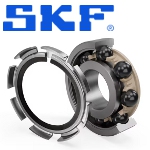 SKF's new Conductive Brush Ring paves the way to greater reliability and longer life in high-performance electric vehicle powertrain systems. Using pure carbon fiber bristles, it provides a reliable electrical connection between an EV eAxle rotor shaft and its housing. When used in combination with SKF Hybrid ceramic ball bearings, it helps to alleviate parasitic current effects that can lead to premature failure in bearings and other components. Available in different configurations for wet (oil-lubricated) motor designs -- and soon for dry (sealed) applications.
Learn more.
Sandia releases interface to help standardize supercomputer power and energy systems
To help moderate the energy needs of increasingly power-hungry supercomputers, researchers at Sandia National Laboratories have released an application programming interface (API) with the goal of standardizing measurement and control of power- and energy-relevant features for high-performance computing (HPC) systems.
The High Performance Computing - Power API specification, still open to collaborators for future development, is vendor-neutral in that it works on HPC products from any manufacturer, and has been vetted through reviews by other laboratories, universities, and commercial collaborators.

The High Performance Computing - Power Application Program Interface is intended to standardize and control power and energy features of high-performance computing systems.
"While the bulk of improvements in energy efficiency will no doubt come from hardware advances, software will play a critical role in maximizing the benefits of new hardware capabilities," said Sandia researcher Jim Laros, who leads the specification development effort.
The specification developed by Laros' team standardizes relevant measurement and control interfaces for a comprehensive range of HPC roles. These range from the hardware level to application interfaces. For example, standardizing how a work-load manager interfaces with the HPC system will enable such features as energy-aware scheduling. This can minimize power usage during the hours in which utility companies often charge higher rates.
"Because future architectures might not be able to operate all components at full capability for a variety of reasons, including temperature considerations or power delivery limitations," said Laros, "our specification defines standard interfaces to facilitate appropriate choices in allocating the available power budget among many, sometimes conflicting and often site-specific, considerations.
"The specification we have developed provides multiple levels of abstractions to satisfy the requirements of multiple types of users or roles."
The Power API specification was developed after study by Sandia and the National Renewable Energy Laboratory (NREL). The work was based on almost a decade of research at Sandia, aided by numerous industry and community relationships that developed over the same period.
A face-to-face review in July included representatives from Cray Inc., Adaptive Computing, Penguin Computing, AMD Inc., IBM, Intel Corp. and NREL, Laros said. Other university and laboratory collaborators, including the University of New Mexico, Oak Ridge and Los Alamos national laboratories, and the Energy Efficient High Performance Computing working group, provided written feedback.
After the open release of version 1.0, an international audience conducted a review in Denver this fall.
"Feedback from both reviews as well as our continued collaborations with the HPC community will strengthen future releases of the specification," said Laros.
The first production implementation of the Power API specification will be on the Trinity supercomputer, the first of the new advanced technology platforms funded by the National Nuclear Security Administration's Advanced Simulation and Computing program.
Laros and his team are available for questions regarding Sandia's power API at jhlaros@sandia.gov. "We welcome feedback and collaboration with anyone who is interested," he said.
Sandia National Laboratories is a multi-program laboratory operated by Sandia Corporation, a wholly owned subsidiary of Lockheed Martin Corp., for the U.S. Department of Energy's National Nuclear Security Administration.
Source: Sandia
Published December 2014
Rate this article
View our terms of use and privacy policy