 |
| March 28, 2017 | Volume 13 Issue 12 |
Mechanical News & Products

Designfax weekly eMagazine

Archives
Partners
Manufacturing Center
Product Spotlight
Modern Applications News
Metalworking Ideas For
Today's Job Shops
Tooling and Production
Strategies for large
metalworking plants
Holding firm: Standard parts with increased clamping force
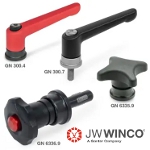 JW Winco has upgraded its proven hand knob nuts, star knob screws, and adjustable hand levers with increased clamping force. Their clamping surface with ball bearing doubles the clamping force while protecting the surface from damage. With typical screws and nuts, roughly half the tightening torque is lost to under-head friction. Get high axial clamping force purely by hand and without tools with these new JW Winco standard parts.
See all your new clamping options.
Cool! Internal threading in hard materials now possible
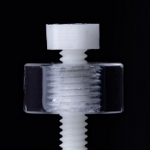 INSACO has a new capability where they can machine an internal thread in ceramic, sapphire, quartz, and other very hard materials. This advance pushes the boundaries of what's possible to support advanced applications that demand high precision and complexity. Ultra-hard materials are alternatives for when metal can't do the job. Ideal for aerospace, medical, and industrial applications.
Learn more. Video available on right side of page.
Sealing fasteners can optimize your designs
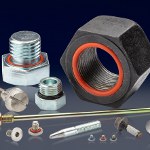 Highly specialized sealing fasteners include sealing screws, sealing nuts, sealing bolts, and sealing washers. Unlike ordinary fasteners, sealing fasteners are configured with a rubber O-ring (or a rubber element) that, when squeezed, permanently seals out a wide range of contaminants from entering and damaging equipment while preventing leakage of toxins into the environment. ZAGO sealing fasteners are designed to withstand harsh weather and extreme temperatures and are vibration and pressure resistant.
Learn all about ZAGO's wide selection of sealing fasteners.
New and improved: Electronic flow control for smarter compressed air use
 EXAIR's newly redesigned EFC™ Electronic Flow Control makes it easier than ever to minimize compressed air use in automated industrial processes. The EFC pairs a photoelectric sensor with programmable timing control to automatically turn on compressed air only when needed, eliminating waste during production gaps. The latest design introduces asynchronous timing for greater control over operating cycles, convenient external programming that eliminates the need to remove the enclosure cover to make adjustments, and a sleek new appearance.
Learn more.
SOLIDWORKS: Mastering sheet metal -- advanced tips and tricks
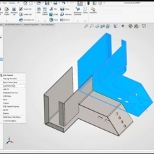 GoEngineer's Brady Daniels, Senior Applications Engineer, gives a master class in next-level sheet metal design. This on-demand webinar covers practical tips and techniques aimed at expanding your understanding and improving real-world workflows. Topics include bend calculations, comparing design approaches, how flat patterns work, and embracing multi-body design. Skip through or take in the whole presentation when you have time. [Credit: Screenshot courtesy of GoEngineer]
View the GoEngineer video.
14 years in a row! Smalley recognized with GM Supplier Quality Excellence Award
 Kudos to the team at Smalley! A continued focus on quality, consistency, and customer support has earned the company -- a world leader in retaining rings and wave springs -- the General Motors' 2025 Supplier Quality Excellence Award, marking the company's 14th consecutive year receiving the hard-to-win recognition.
Read the full article.
Award-winning bio-based instant engineering adhesive resists heat and humidity
 Bostik has launched Born2Bond™ Ultra K85, the first-ever instant engineering adhesive processed from 60% bio-based raw materials. This material has been created for design engineers, product designers, and manufacturers looking for an ultra-durable adhesive that provides exceptional resistance to humidity and high temperatures. It delivers premium performance -- even bonding dissimilar materials -- while not compromising on safety, health, or the environment. It earned the Adhesive & Sealant Industry's 2026 Innovation Award.
Learn more.
Siemens Meet at the Machine: Be productive from day one of new CNC machine delivery
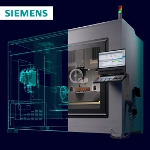 Traditionally, many programming, validation, and training activities begin only after a machine is installed. Not anymore. Meet at the Machine is Siemens' new initiative uniting machine builders, software, and automation for next-level CNC through a continuous digital thread across engineering, programming, virtual validation, and execution. By pairing a Digital Twin with Digital CNC powered by SINUMERIK, manufacturers can prepare, validate, train, and optimize workflows before your specialized machine's physical delivery! TRAK Machine Tools is the launch partner -- see what they are doing.
Learn more.
How to master metal powder management in 3D printing
 What's the real cost of "good enough" powder tracking for powder-bed fusion 3D-printing machines? According to Tim Wischeropp, CEO and Co-Founder of amsight, the technology is rife with hidden costs. Every cycle, every handling step, every exposure, and every mixing decision plays a part. Surprisingly, though, with the right strategy, users can turn their losses into a competitive edge. Learn how.
Read the full article.
Aluminum oxide filament for FDM printers
 Virtual Foundry, the company that brought us 3D-printable lunar regolith simulant, has a new product called Aluminum Oxide Filamet™, giving users the power to print alumina parts using the FDM printers they already own. This composite 3D-printing material allows researchers, engineers, and makers to bypass expensive ceramic tooling and produce pure ceramic components in-house. Print using a 0.6-mm hardened-steel, standard-flow nozzle on virtually any open-architecture printer.
Get all the material specs.
New metal extrusion retrofit system helps manufacturers get into ShAPE
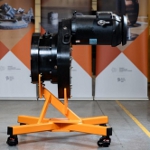 A new invention from the Department of Energy's Pacific Northwest National Laboratory could soon help manufacturers more easily adopt the lab's patented Shear Assisted Processing and Extrusion (ShAPE™) technology, enabling faster manufacturing of superior extrusion products while reducing costs and energy use.
Read the full article.
Pneumatics: Dual guide rod cylinders and exhaust silencers
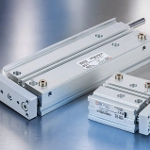 Automation-Direct has expanded its guided actuator lineup with compact 12-mm dual guide rod cylinders from Metal Work. Ideal for packaging and material handling, these double-acting cylinders feature 10-mm to 250-mm strokes, magnetic pistons, and integral sensor slots. Additionally, new durable acetal plastic silencers are now available in multiple NPT/BSPP sizes to reduce pneumatic exhaust noise.
Learn more.
Expanded injection molding capabilities
 Pexco LLC has acquired Recto Molded Products and Legacy Extrusions, expanding its capabilities in complex injection molding, tooling, assembly, and engineered thermoplastic solutions for OEM manufacturers. The Cincinnati-based companies bring more than a century of manufacturing expertise, advanced production technologies, and value-added services that strengthen Pexco's ability to support customers from product design through full-scale production. Injection molding presses ranging from 55 to 500 tons.
Learn about Pexco and its value-added manufacturing services.
Custom 3D-printed steering wheel for jet dragster
 Jet dragsters use General Electric J85 engines -- the same turbines pulled from U.S. military F5 Freedom Fighters -- mounted to a custom 26-ft chassis. The racers achieve quarter-miles in 5.5 sec, but standard metal parts can fail custom ergonomic needs. Traditional manufacturing of low-volume aluminum steering wheels demands long, 8-day lead times, high costs, and multi-piece assemblies. Larsen Motorsports solved this by replacing metal with continuous fiber 3D printing using the Markforged X7. Embedding continuous carbon fiber into an Onyx nylon matrix allowed them to target specific load paths, delivering a custom steering wheel that is stiffer, lighter, and faster to produce than aluminum.
View the video.
Application Spotlight: Light-duty ring in an air vent nozzle
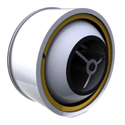 Explore how a light-duty Spirolox® retaining ring is used in an airplane air vent nozzle to regulate airflow. This application spotlight shows how the ring fits into a groove in the plastic housing, securing the nozzle during rotation. Designed for light loads and axial positioning, it offers a simple, economical solution that is easy to install and remove.
View this informative Smalley video.
3D printing with cellulose: Material can be made to outperform ABS and have special properties
World's most abundant polymer could rival petroleum-based plastics as source of printing feedstock.
By David L. Chandler, MIT
For centuries, cellulose has formed the basis of the world's most abundantly printed-on material: paper. Now, thanks to new research at MIT, it may also become an abundant material to print with -- potentially providing a renewable, biodegradable alternative to the polymers currently used in 3D-printing materials.
"Cellulose is the most abundant organic polymer in the world," says MIT postdoc Sebastian Pattinson, lead author of a paper describing the new system in the journal Advanced Materials Technologies. The paper is co-authored by associate professor of mechanical engineering A. John Hart, the Mitsui Career Development Professor in Contemporary Technology.
Cellulose, Pattinson explains, is "the most important component in giving wood its mechanical properties. And because it's inexpensive, biorenewable, biodegradable, and also very chemically versatile, it's used in a lot of products. Cellulose and its derivatives are used in pharmaceuticals, medical devices, as food additives, building materials, clothing -- all sorts of different areas. And a lot of these kinds of products would benefit from the kind of customization that additive manufacturing [3D printing] enables."
Meanwhile, 3D printing technology is rapidly growing. Among other benefits, it "allows you to individually customize each product you make," Pattinson says.
Using cellulose as a material for additive manufacturing is not a new idea, and many researchers have attempted this but faced major obstacles. When heated, cellulose thermally decomposes before it becomes flowable, partly because of the hydrogen bonds that exist between the cellulose molecules. The intermolecular bonding also makes high-concentration cellulose solutions too viscous to easily extrude.
Instead, the MIT team chose to work with cellulose acetate -- a material that is easily made from cellulose and is already widely produced and readily available. Essentially, the number of hydrogen bonds in this material has been reduced by the acetate groups. Cellulose acetate can be dissolved in acetone and extruded through a nozzle. As the acetone quickly evaporates, the cellulose acetate solidifies in place. A subsequent optional treatment replaces the acetate groups and increases the strength of the printed parts.
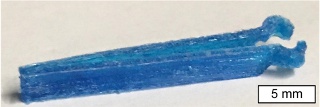
To demonstrate the chemical versatility of the production process, MIT researchers added a small amount of antimicrobial dye to the cellulose acetate ink and 3D-printed a pair of surgical tweezers with antimicrobial functionality. [Image: MIT]
"After we 3D print, we restore the hydrogen bonding network through a sodium hydroxide treatment," Pattinson says. "We find that the strength and toughness of the parts we get ... are greater than many commonly used materials" for 3D printing, including acrylonitrile butadiene styrene (ABS) and polylactic acid (PLA).
To demonstrate the chemical versatility of the production process, Pattinson and Hart added an extra dimension to the innovation. By adding a small amount of antimicrobial dye to the cellulose acetate ink, they 3D-printed a pair of surgical tweezers with antimicrobial functionality.
"We demonstrated that the parts kill bacteria when you shine fluorescent light on them," Pattinson says. Such custom-made tools "could be useful for remote medical settings where there's a need for surgical tools but it's difficult to deliver new tools as they break, or where there's a need for customized tools. And with the antimicrobial properties, if the sterility of the operating room is not ideal the antimicrobial function could be essential," he says.
Because most existing extrusion-based 3D printers rely on heating polymer to make it flow, their production speed is limited by the amount of heat that can be delivered to the polymer without damaging it. This room-temperature cellulose process, which simply relies on evaporation of the acetone to solidify the part, could potentially be faster, Pattinson says. And various methods could speed it up even further, such as laying down thin ribbons of material to maximize surface area, or blowing hot air over it to speed evaporation. A production system would also seek to recover the evaporated acetone to make the process more cost effective and environmentally friendly.
Cellulose acetate is already widely available as a commodity product. In bulk, the material is comparable in price to that of thermoplastics used for injection molding, and it's much less expensive than the typical filament materials used for 3D printing, the researchers say. This, combined with the room-temperature conditions of the process and the ability to functionalize cellulose in a variety of ways, could make it commercially attractive.
The research was supported by the National Science Foundation.
Published March 2017
Rate this article
View our terms of use and privacy policy