 |
| October 21, 2014 | Volume 10 Issue 39 |
Materials News & Products
Designfax weekly eMagazine

Archives
Partners
Manufacturing Center
Product Spotlight
Modern Applications News
Metalworking Ideas For
Today's Job Shops
Tooling and Production
Strategies for large
metalworking plants
How to master metal powder management in 3D printing
 What's the real cost of "good enough" powder tracking for powder-bed fusion 3D-printing machines? According to Tim Wischeropp, CEO and Co-Founder of amsight, the technology is rife with hidden costs. Every cycle, every handling step, every exposure, and every mixing decision plays a part. Surprisingly, though, with the right strategy, users can turn their losses into a competitive edge. Learn how.
Read the full article.
Aluminum oxide filament for FDM printers
 Virtual Foundry, the company that brought us 3D-printable lunar regolith simulant, has a new product called Aluminum Oxide Filamet™, giving users the power to print alumina parts using the FDM printers they already own. This composite 3D-printing material allows researchers, engineers, and makers to bypass expensive ceramic tooling and produce pure ceramic components in-house. Print using a 0.6-mm hardened-steel, standard-flow nozzle on virtually any open-architecture printer.
Get all the material specs.
DURACON polymer with 30% recycled content
Daicel Corporation's High Performance Polymers SBU has launched four new DURACON® POM grades featuring 30% post-consumer recycled (PCR) content. Unveiled at CHINAPLAS 2026, the lineup includes Standard, Low VOC, Sliding, and Tough options. Leveraging advanced compounding expertise, Daicel maintains quality and mechanical performance comparable to standard virgin resin grades for demanding global industrial and automotive components.
Learn more.
Radio Flyer cuts ebike prototype time radically with Fuse X1 large-format SLS 3D printer
Radio Flyer cut prototype lead times for its Flyer Loop cargo ebike frame from two months to two days using Formlabs' new Fuse X1 SLS large-format 3D printer. "We can now print an entire Flyer Loop cargo ebike overnight and be gluing it together the next day," said Agostino LoBello, product development engineer at Radio Flyer. "I can iterate three times as often with nine times less labor." The Fuse X1 delivers production-quality parts with 50% lower costs and triple the throughput of comparable industrial systems, featuring automated powder handling and a compact, easy-to-install design. [Credit: Image courtesy of Formlabs]
View the video.
Compact industrial sand 3D printer
ExOne has launched the S-Print Pro, a compact industrial sand 3D printer that brings production-grade binder jetting to smaller foundries, pattern shops, and print service providers. Aimed at businesses competing on cost and flexibility, it handles low-volume casting, spare parts, and custom components. The system processes furan binder with silica sand, CeraBeads, or silicon carbide.
Learn more about this capable machine.
Fast-cure composite for aero and defense manufacturing
Toray Composite Materials America has launched 3960-FC, a fast-cure variant of its high-performance 3960 prepreg system for mission-critical aerospace and defense applications. This material reduces cure time by up to 45% while maintaining proven mechanical performance, stiffness, and exceptional toughness. It is highly compatible with automated manufacturing technologies like AFP and ATL, as well as traditional processing methods.
Learn more.
Metal finishing: With rising carbide prices, when cermet makes sense
As critical raw material access tightens, manufacturers are rethinking cutting tool usage. While essential, carbide is often unnecessary for finishing processes. Cermet -- a ceramic-metal composite -- offers an excellent alternative, delivering exceptional fracture and wear resistance for these specific machining stages.
Read the full article.
Full-color 3D-printing Design Guide from Xometry
With Xometry's PolyJet 3D-printing service, you can order full-color 3D prints easily. Their no-cost design guide will help you learn about different aspects of 3D printing colorful parts, how to create and add color to your models, and best practices to keep in mind when printing in full color. Learn how to take full advantage of the 600,000 unique colors available in this flexible additive process.
Get the Xometry guide.
Next-gen SLA materials rival traditional thermoplastics
Formlabs has announced two new SLA materials that bring 3D printing significantly closer to being a manufacturing method for end-use part production. Tough 1000 Resin and a significantly improved Tough 2000 Resin join Tough 1500 Resin, forming the new Tough Resin family. These resilient engineering materials stand up to harsh environments, impact, and repeated wear, all while delivering a dark, matte surface finish with crisp details when printed on Form 4 Series 3D printers.
Learn more.
Surface inspection: From Army depot to factory floor
Born from U.S. Army requirements for rotorcraft inspection, the GelSight Modulus 3D surface measurement system has surpassed 100 units sold to commercial and Department of Defense customers. The handheld, micron-scale tool with interchangeable probe tips delivers fast, high-res measurements in places traditional tools can't reach.
Read the full article.
What is Cold Metal Fusion?
Cold Metal Fusion is an open industry standard for sinter-based metal additive manufacturing. It combines polymer SLS design freedom with reliable debinding and sintering workflows, enabling complex geometries, lightweighting, lattice structures, conformal cooling channels, and high-precision metal parts with predictable shrink behavior. Now available from TriMech Group, this process offers a faster, cost-effective way to produce strong, high-performance metal parts.
Learn more from TriMech Group.
Metal 3D printing: EOS adds four new materials
Industrial 3D-printing supplier EOS has added four new metal additive manufacturing materials to its portfolio: an iron-nickel alloy that boasts stability under fluctuating temps, a nickel alloy with high strength and extreme corrosion resistance, a low-alloyed steel prized for its high toughness and strength, and an industrial-grade stainless steel. Each has been optimized for EOS Laser Powder Bed Fusion systems.
Get all the details.
New materials and finishes from Quickparts
Quickparts has introduced DuraKor, ThermaKor, and vapor smoothing to expand its production-capable materials and finishing portfolio. The new plastics provide polypropylene-like toughness, chemical resistance, and high-temperature stability, while vapor smoothing improves sealing and surface quality. Together, these capabilities help engineers validate designs, refine performance, and transition efficiently from prototypes to scalable manufacturing.
Learn more.
What's the latest in SLA 3D printing?
Learn about the latest offerings in SLA printing from 3D Systems, including the introduction of SLA 825 Dual, the company's most advanced large-frame Stereolithography printer. Other new products include ArrayCast investment casting software that allows users to effortlessly create customized casting trees (complete with configurable runners, sprues, and end effectors), Accura SbF (the latest SLA casting resin), and Accura Xtreme Black (which delivers low shrinkage, large, functional SLA prototype parts with sharp detail).
Learn about all the new 3D Systems products.
meviy cuts CNC milling lead times to just 4 days
meviy, the on-demand custom parts manufacturing service developed by MISUMI Group, has upgraded its Expedite+ service with improved lead times for CNC Milled parts. Customers can now have their parts shipped in as few as four days through meviy's fastest delivery option. The enhanced service helps manufacturers and engineers stay on schedule when projects are behind or production is interrupted. Supported materials include steels and aluminums. Check out their instant quoting too.
Learn more.
New technique to make foams could lead to lightweight, sustainable materials
By Brett Israel, Georgia Tech
At its most basic level, foam is a bunch of bubbles squished together. Liquid foams, a state of matter that arises from tiny gas bubbles dispersed in a liquid, are familiar in everyday life, from beer to bathwater. They also are important in commercial products and processes, including pharmaceutical formulation, oil production, food processing, cleaning products, cosmetics, or hair and skin care products. Lightweight dry foams for the construction of buildings, automobiles, and airplanes are key materials in the push for sustainability and energy efficiency. Making lightweight foam has one big challenge, however: keeping the foam stable.
A team of researchers from the Georgia Institute of Technology has developed a new type of foam -- called capillary foam -- that solves many of the problems faced by traditional foams. The new research shows for the first time that the combined presence of particles and a small amount of oil in water-based foams can lead to exceptional foam stability when neither the particles nor the oil can stabilize the foams alone.
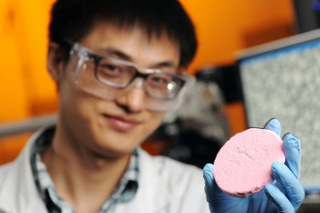
Yi Zhang, a graduate student co-advised by Prof. Sven Behrens and Prof. Carson Meredith in the School of Chemical & Biomolecular Engineering at Georgia Tech, is shown holding a porous solid material prepared from a capillary foam. [Photo Credit: Gary Meek]
"It's very difficult to stabilize foams, and we want foams that are stable for months or years," said Sven Behrens, study co-author and professor in the School of Chemical & Biomolecular Engineering at Georgia Tech. "We've developed a way to make foams that is much easier and more broadly applicable that what is traditionally used."
The study was sponsored by the National Science Foundation (NSF). The research was published online October 3, 2014, in the journal Angewandte Chemie. The new capillary foams were developed by graduate student Yi Zhang, who is co-advised by Behrens and Carson Meredith, also a professor in the School of Chemical & Biomolecular Engineering.
The main ingredients for foam are air and water. Surfactants, which are similar to detergents, are then traditionally added to stabilize foams. Another traditional way to stabilize foam is to add microscopic particles, like talc powder. Both approaches require that the additive have a specific set of properties, which isn't always possible with the materials available.
The new study demonstrates how the addition of a tiny amount of oil allows the use of particles with more general properties.
"It sounds like we're making the system more complicated by adding oil to the mix, but it's a small amount of oil that could be something as simple as vegetable oil," Meredith said.
The new capillary foams expand the range of particles useful for stabilizing foams that are made of air and water. Air bubbles are stabilized by the combined action of the particles and the small amount of oil. This synergy of oil and particulate is counterintuitive because oils usually decrease foam stability and are commonly used as defoaming agents. But like the water-bridged grains of sand that hold a sand castle together, particles in the capillary foam form a stabilizing network connected by oil bridges.
"This is a novel phenomenon that people haven't discussed before, so we need to know more about why this works," Meredith said.
Lightweight dry foams made by this process could be used in many industries, from construction to automobile and airplane manufacturing.
"We're looking at several different application areas where it could be used as a product," Behrens said.
This research is supported by the Renewable Bioproducts Institute of Georgia Tech, by the National Science Foundation, and by the Air Force Office of Scientific Research. Any conclusions or opinions are those of the authors and do not necessarily represent the official views of the sponsoring agencies.
CITATION: Yi Zhang, et. al., "A new class of liquid foams stabilized by synergistic action of particles and immiscible liquid." (September 2014, Angewandte Chemie) http://dx.doi.org/10.1002/ange.201405816
Published October 2014
Rate this article
View our terms of use and privacy policy