
Artificial turf gains ground with realistic simulation
Royal TenCate uses Abaqus FEA to evaluate real-world performance of synthetic sports field design
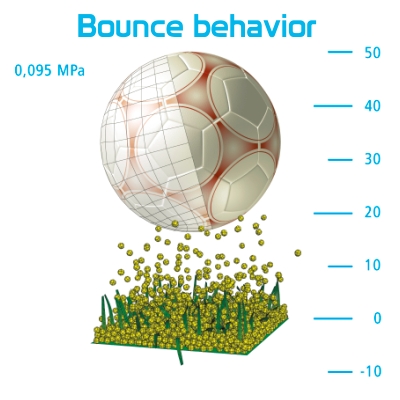
Artificial turf is accepted for soccer fields around the world by FIFA, the sport’s governing body, provided it meets tough design and manufacturing standards. This ball-bounce model made using Abaqus FEA shows the interaction and response of synthetic turf infill and fibers to the impact of a soccer ball.
The Fédération Internationale de Football Association (FIFA), founded in 1904 to promote the sport of soccer, has deemed artificial turf “an acceptable playing surface for football” and cites numerous advantages over natural grass. These include the availability of an evergreen, even-playing surface that makes for a quick, precise game favoring both technical and physical players. In addition, artificial turf fields can be played on more often than natural ones, are not affected by inclement weather, and are less expensive to maintain.
But FIFA has also spelled out detailed regulations about the materials, substructure, installation, testing, and certification of artificial turf for playing fields — which means that turf manufacturers have to be on the top of their game when designing their products for performance and safety.
Textiles go hi-tech
Royal TenCate (pronounced “ten-kah-teh”) is the world’s leading producer of synthetic grass fibers and other components for playing fields. The 300-year-old Dutch company, among the founders of Holland’s once-thriving textile industry, branched out into synthetics in the 1970s as competition from Asia impacted the natural fiber market. TenCate’s centuries of success has won them the “Royal” label from the Dutch monarchy; today, in addition to dominating the artificial turf market, their products include specialist fabrics for fire-fighting, lightweight materials for use in aircraft, and high-strength fabrics for use in geotubes for tents and awnings — all of which demand significant engineering expertise.
For turf design, expertise is a must. Consider the amount of pounding from feet, balls, and falling bodies that a playing field must endure — whether the game is soccer, football, rugby, field hockey, or lacrosse. Add different climates (hot versus cold, wet versus dry) and impact patterns (heavily padded American football teams versus bare-kneed soccer players) and you begin to get an idea of all the variables that TenCate must take into account when designing artificial turf.
Synthetic turf: More than meets the eye
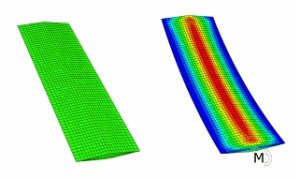
Reden’s modeling strategy for TenCate’s artificial turf starts on a micro level with Abaqus FEA analysis of an individual synthetic fiber, shown here. Mass, shape, bendability, height, and other characteristics can be modified and retested until the desired requirements are met.
Of course, since you are mimicking the real thing, synthetic grass needs to be green. But starting with a single blade of the artificial version, you also need to consider what yarn/fiber to use (softer polyethylene for soccer, tougher polyamides for U.S. football), what shape it should be, whether it should be fibrillated or a monofilament, its height above the field surface, its density per square meter, stiffness, and dissipative behavior — all of which affect wear, safety, and playing characteristics.
However, what’s just below the visible surface of the grass is also critical: the fiber travels down through infill made of rubber or thermoplastic granulate, which provides shock absorption, controls rebound, and prevents skin damage caused by sliding. Beneath that are additional layers of rubber and sand and, finally, the backing in which the grass blade (totaling 6 cm in length) is imbedded. Much like the base of a carpet, this backing is expected to lie perfectly flat without folding, shrinking, or deforming. And everything must withstand fluctuations in temperature, humidity, and all kinds of weather.
Better performance starts with FEA
The TenCate Grass division manufactures a complete line of the four major components of synthetic turf: fiber, infill, backing, and sub-bases. “For optimum performance you need to fine-tune all the elements that make up a field,” says Martin Olde Weghuis, international manager, R&D, at TenCate. “We make distinct types of polyethylene grass fibers, plus thermoplastic infill material, and polypropylene woven backing fabrics — all of which must work together for optimum results.”
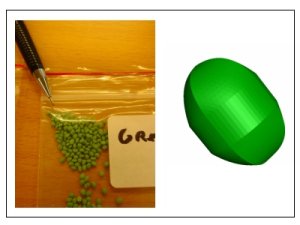
Rubber or thermoplastic infill sample (left) and FEA model of individual granule (right).
Marco Ezendam, director of Reden BV (Research Development Nederland), engineering consultants to TenCate, explains “A playing field is an entire system, not just individual components. If you want better performance from the field you have to know how the entire system functions and what the interactions are within it. That’s the reason we started modeling turf design with finite element analysis (FEA).”
Reden supports TenCate’s product design and development process using Abaqus FEA software from SIMULIA, the Dassault Systèmes brand for realistic simulation. “We initially chose Abaqus because of the breadth of its materials models,” Ezendam says. “The capabilities of the software have grown along with our need for increased sophistication in our analyses. With FEA you can model the individual characteristics of each component and relate that to the behavior of the total system.”
How to model a playing field
When creating artificial turf models, Reden looks at the problem at a number of levels: micro (the properties of an individual fiber), meso (grains of infill interacting with fibers), and macro (a ball or player impacting the field). “We use FEA to model the properties of a single fiber, translate those into the properties of a group of fibers, and then predict the characteristics of the mass, spring, and damping of the field itself interacting with a ball or player,” says Ezendam.
A grass-fiber model in Abaqus can be subjected to virtual bending tests, and its mass, shape, height, etc. modified and retested, until the desired characteristics are achieved. Infill models can be adjusted for morphology, size, material, distribution, friction, and layer thickness, and then run through triaxial (three-dimensional) compression tests. An entire square of turf, with fibers, infill, and backing characteristics built into the model, can be evaluated for compression by a virtual foot or a bouncing ball.

The Abaqus FEA data from fiber and infill testing is combined into field properties models with which load (top left) and displacement (top right) effects can be simulated. Field testing using the “artificial athlete” (photo) verifies the results predicted by the model.
The artificial athlete gets to play first
The foot simulation mirrors a real-world test, mandated by FIFA, that is known as the “artificial athlete.” It consists of a circular plate, approximating a player’s foot, that is pressed onto the field with a loaded spring to measure field behavior. Reden uses two artificial athletes: the Berlin tests the maximum load on the plate, and the Stuttgart measures displacement of the plate. The athletes are put through their paces on the synthetic turf at TenCate’s outdoor testing fields.
By using FEA during product development, Reden can simulate the effects of the artificial athlete tests on their turf models. They can then use the simulations to evaluate the performance of different combinations of turf fiber, infill, and backing, and make modifications that will optimize the turf’s performance in the outdoor tests.
In a similar manner, the ball-bounce analysis is set up using an FEA shell model of a ball full of gas at the correct pressure. For comparison, a real ball is bounced off a surface. The rebound results are then factored into the simulation of the synthetic turf response and used to make product modifications as needed.
FEA measures up to FIFA standards
With its computer models set up, Reden turns to validation testing against the FIFA-mandated parameters that must be met by every synthetic field. The Abaqus analysis is run on a 64-bit, double CPU, 8-GB internal memory machine with a Linux 9.2 operating system. While a single turf-fiber model is fairly simple to build, a full model of a simulated foot impacting a section of turf can have over 250,000 elements with over two million degrees of freedom. “We are now at the point of validating all our models, and the graphs of our real-world results against what our FEA models predict are coming out very strong,” says Ezendam.
Reden plans further testing and modeling of artificial turf behavior with Abaqus to support continued product design and development for TenCate. One result of their teamwork was recently seen on the world stage: TenCate provided all the synthetic field hockey turf for the Beijing Olympics.
Want more information? Click below.
Dassault Systèmes — SIMULIA
© Nelson Publishing, Inc. All Rights Reserved